Effects of prolonged post-fixation on vascular biomarkers in postmortem human brains

Effects of prolonged post-fixation on vascular biomarkers in postmortem human brains
Frigon, E.-M.; Ma, W.; Tremblay, C.; Boire, D.; Maranzano, J.; Dadar, M.; Zeighami, Y.
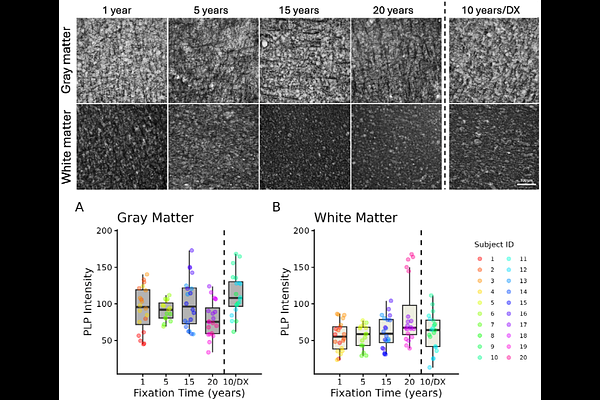
AbstractPostmortem human brains stored in brain banks are important research resources to study the mechanisms underlying normal brain functions as well as various neurodegenerative disorders. Immunohistochemical (IHC) and histochemical (HC) staining have been used to examine human brains post-fixed in neutral-buffered formalin (NBF) for months, years, and even decades. As such, it is essential to establish the effects of prolonged post-fixation in NBF on both IHC and HC stains. Previously, we found that prolonged NBF post-fixation resulted in differential effects on IHC and HC staining on postmortem brains. In this study, we further examined the effects of prolonged post-fixation on IHC stains targeting 6 antigens and 2 HC stains of known biomarkers of cerebrovascular diseases in prefrontal cortex of human brains post-fixed for 1, 5, 10, 15, and 20 years. The IHC targets included microvasculature markers of the blood brain barrier (Collagen-IV and Claudin-5), a type III intermediate filament marker (Vimentin), an activated microglia marker (CD68), a biomarker for oligodendrocytic myelin proteolipid protein (PLP) and a marker for iron accumulation (Ferritin). The HC included Masson's Trichrome Stain (MTS) and Bielschowsky silver stain (BSS). We found that staining intensities of Ferritin, Vimentin, Collagen-IV and BSS decreased with prolonged postfixation, while no significant differences were observed in the staining intensity of other markers. Hence, these differential alterations should be taken into consideration when interpreting the results from processed tissues with prolonged post-fixation. We recommend performing IHC and HC staining for human brains with the same post-fixation times to offset any impact on downstream neuropathological analyses, as well as adding the post-fixation duration as a covariate in the analysis.