2D magnetohydrodynamic jet simulations: properties of recollimation shocks

2D magnetohydrodynamic jet simulations: properties of recollimation shocks
Stella Boula, Fabrizio Tavecchio, Gianluigi Bodo, Nektarios Vlahakis, Paolo Coppi
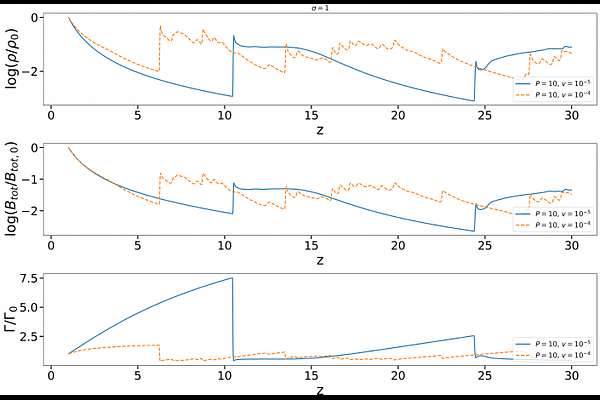
AbstractRecollimation shocks are a frequent outcome in overpressured relativistic jets and are crucial for interpreting stationary features in Active Galactic Nuclei. The precise influence of magnetic fields on jet stability, energy dissipation, and variability remains debated, particularly as different field configurations can significantly alter shock properties and the onset of fluid instabilities. We perform a study of 2D axisymmetric RMHD jets to quantify how the ambient density contrast ($ν$), pressure ratio ($P$), magnetization ($σ$), and magnetic pitch parameter ($α$) govern the formation and strength of the first recollimation shock. We also assess how these parameters create the local geometric conditions favorable for the centrifugal instability (CFI), utilizing linear theory as a diagnostic. We find that the jet's global geometry is affected by the magnetic pressure. The recollimation distance decreases monotonically with increasing magnetization $σ$, as increased magnetic forces immediately limit jet expansion. Remarkably, in the magnetically dominated regime, the ratio of the magnetized recollimation distance ($z_{\rm MHD}$) to its purely hydrodynamic counterpart ($z_{\rm HD}$) converges onto a power-law scaling, $z_{MHD}/z_{HD} \propto (B_0^2/P_{ext})^{-1/3}$, where $B_0$ the initial magnetic field and $P_{ext}$ the external pressure. Jets with high density contrast relative to the ambient medium or high internal pressure further enhance field compression. Furthermore, synthetic synchrotron maps show that a dominant toroidal field yields highly boosted, localized emission knots, whereas a strong poloidal field creates a diffuse profile and shifts the recollimation zone downstream. Regions susceptible to CFI are determined primarily by the local $σ_{\text{tor}}/Γ^2$ profile and streamline curvature created during recollimation.