Does bilingualism buffer genetic predispositions to reading difficulties through alterations of structural interhemispheric connectivity? An ABCD Study.

Does bilingualism buffer genetic predispositions to reading difficulties through alterations of structural interhemispheric connectivity? An ABCD Study.
Lallier, M.; Rius-Manau, C.; 23andMe Research Team, ; Carrion-Castillo, A.
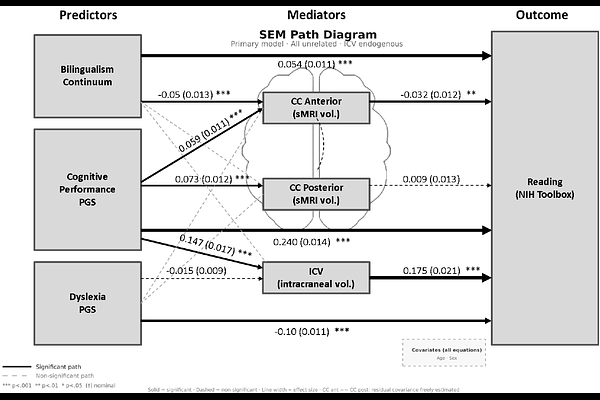
AbstractHere, we test the hypothesis that early sustained exposure to complex bilingual environments can positively affect reading development by altering structural interhemispheric connectivity via the corpus callosum (CC). Interhemispheric connectivity has been shown to be inefficient in dyslexia, but also to support compensatory pathways when genetic risk for reading difficulties is present, by enabling the preserved right hemisphere to support a dysfunctional left hemisphere. Mediation models were conducted on children aged 9-10 years (with a 2-year follow-up assessment) from the Adolescent Brain Cognitive Development database (N>10,000). Polygenic scores (PGS) for dyslexia and cognitive performance and continuous bilingualism indices were used as predictors, with reading aloud as the outcome. Bilingualism showed a positive effect on reading partially mediated by the anterior CC, independently of overall brain size. In contrast, genetic predispositions to reading difficulties influenced reading primarily through overall brain size rather than CC connectivity specifically. These two pathways were independent, suggesting that bilingual experience and genetic risk operate through distinct neuroanatomical mechanisms. These findings suggest that recurrent early exposure to complex bilingual environments may shape the brain's structural connectivity toward a more balanced and integrated bilateral frontal organisation. The results highlight potential brain compensatory pathways induced by environmental experiences that may support more efficient reading development and mitigate risks for developmental dyslexia.