The Role of Juvenile Hormone in Midgut Remodeling During Drosophila melanogaster Diapause

The Role of Juvenile Hormone in Midgut Remodeling During Drosophila melanogaster Diapause
Burtsev, H.; Tatar, M.
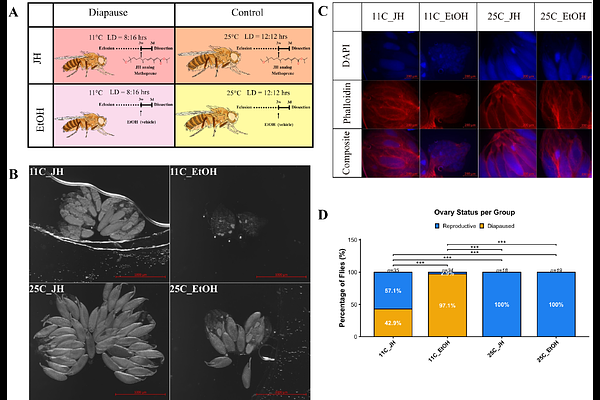
AbstractMany insects enter diapause, a programmed state of developmental arrest that enables survival under adverse environmental conditions. In Drosophila melanogaster Meigen, 1830, diapause is characterized by reproductive arrest and reduced intestinal growth, accompanied by suppressed intestinal stem cell (ISC) activity. Juvenile Hormone (JH) promotes ISC proliferation under favorable conditions, but its capacity to modulate stem cell dynamics during cold-induced diapause remains unclear. Here, we investigated whether JH signaling can reactivate midgut remodeling in adult females maintained at 11. At this temperature, flies exhibited pronounced gut atrophy and elevated Phospho-histone H3 (PH3+) cell abundance, consistent with temperature-dependent G2/M phase arrest JH treatment significantly increased the proportion of Delta-positive progenitor cells in the anterior (R2) and posterior (R5) midgut regions at both 11 and 25, demonstrating that JH acts as a conserved mitogen for the ISC pool irrespective of thermal environment. A trend toward reduced PH3+ accumulation in the posterior midgut following JH treatment (p = 0.061) suggests possible facilitation of mitotic exit, though this effect did not reach statistical significance. Despite cellular-level changes, JH treatment did not restore overall gut size, indicating that the 72-84 hour exposure window was insufficient for subsequent tissue hypertrophy. Additionally, we identified a recurrent cold-induced pathology of gut distension, provisionally termed Lumen Obstruction Syndrome (LOS), which was independent of JH signaling. These findings reveal an uncoupling of JH-driven stem cell expansion from gross organ growth under diapause conditions, highlighting the selective sensitivity of the ISC compartment to endocrine signaling during environmental stress.