Relativistic Scattering in the Funnel of Cygnus X-3

Relativistic Scattering in the Funnel of Cygnus X-3
Suraj K. Chaurasia, Ranjeev Misra, Amit Pathak
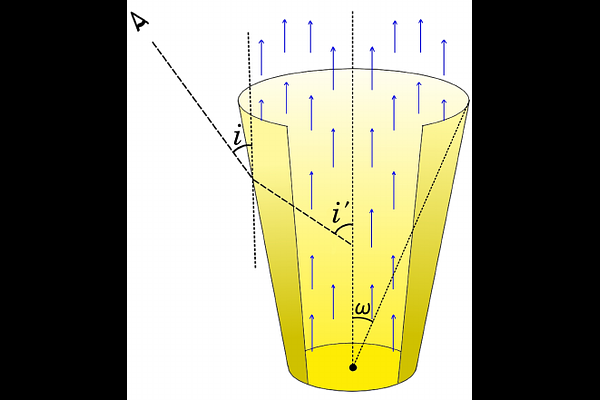
AbstractCygnus X-3 presents significant challenges to standard accretion models. Recent polarimetric observations by IXPE reveal high polarization degrees (PD) in the hard state ($\sim 23\%$) and unexpectedly significant polarization in the soft state ($\sim 12\%$), which are difficult to reconcile with static scattering models at low inclination ($i \approx 30^\circ$). We present a relativistic scattering model within a funnel-shaped geometry that resolves this discrepancy. We show that a single funnel-outflow configuration with variable bulk velocity $β$ can reproduce both polarization states, with lower velocities ($β\approx 0$) yielding $\sim 12\%$ polarization (soft state) and mildly relativistic velocities ($β\lesssim 0.4$) producing $\sim 23\%$ polarization (hard state) at $i \approx 30^\circ$ for half funnel opening angles of $\sim 13^\circ$-$16^\circ$. Relativistic aberration modifies the effective scattering angle in the comoving frame, enhancing polarization in the hard state while recovering the static limit in the soft state. The model also yields a consistent estimate of the intrinsic luminosity, of order $\sim 10^{40}$ erg s$^{-1}$, supporting a super-Eddington interpretation. This framework provides a unified explanation of the observed polarization properties of Cygnus X-3.