Measuring the Angular Auto-power Spectrum of Fast Radio Burst Dispersion Measures as a Robust Cosmological Probe and Baryon Tracer

Measuring the Angular Auto-power Spectrum of Fast Radio Burst Dispersion Measures as a Robust Cosmological Probe and Baryon Tracer
Bao Wang, Zhiyu Lu, Yang Liu, Jun-Jie Wei, Xue-Feng Wu
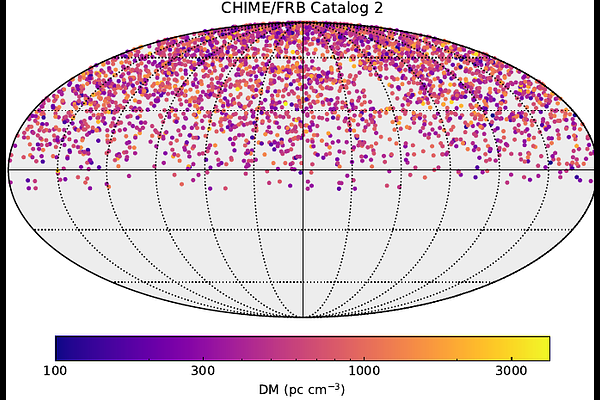
AbstractFluctuations in the cosmic electron density are imprinted on the dispersion measures (DMs) of fast radio bursts (FRBs), making DMs a promising probe of cosmology and the spatial distribution of ionized baryons. In this work, we present the first measurement of the angular auto-power spectrum of FRB DMs, using 3455 apparently non-repeating bursts from the CHIME/FRB Catalog 2. We detect an angular correlation signal at $>3σ$ significance, associated with large-scale electron-density fluctuations. By fitting the measured spectrum to theoretical models, we constrain two key parameter combinations: $Ω_{\rm b}h^2$-$H_0$, which probes the cosmic baryon density and expansion rate, and $Ω_{\rm b}h^2$-$f_{\rm d}$, which traces the baryon fraction in cosmic large-scale structure (LSS). We further assess the robustness of the power-spectrum method against systematic uncertainties arising from the assumed FRB redshift distribution and from the DM contributions of host galaxies (${\rm DM}_{\rm host}$), the Galactic halo (${\rm DM}^{\rm MW}_{\rm halo}$), and the Milky Way interstellar medium (${\rm DM}^{\rm MW}_{\rm ISM}$), using mock samples. Our results demonstrate that the angular power spectrum is largely insensitive to uncorrelated DM components such as ${\rm DM}_{\rm host}$, thereby effectively mitigating the impact of poorly constrained host-galaxy systematics. In contrast to the traditional ${\rm DM}_{\rm LSS}$-$z$ relation, this method does not require individual redshift measurements--it relies only on the overall redshift distribution--and it partially breaks the parameter degeneracies in the $Ω_{\rm b}h^2$-$H_0$ and $Ω_{\rm b}h^2$-$f_{\rm d}$ planes. These findings establish the DM angular power spectrum as a robust cosmological probe and a powerful baryon tracer.