Photopatterned spatiotemporal organisation and in situ differentiation of 3D human cortical networks

Photopatterned spatiotemporal organisation and in situ differentiation of 3D human cortical networks
Dong, S.; Weyland, D.; Heidari, H.
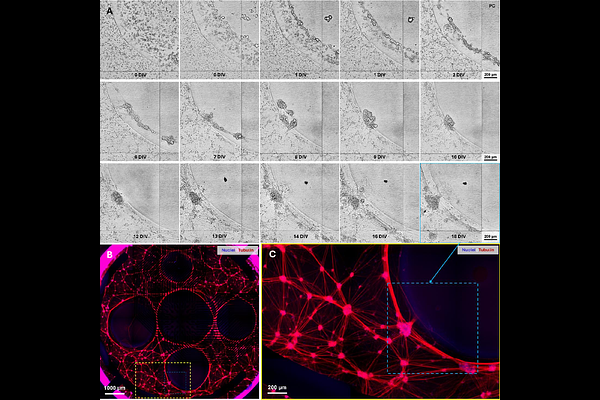
AbstractModelling human cortical microcircuitry in vitro requires platforms that recapitulate both the compositional complexity and spatial architecture of developing neural tissue. Current organoid and assembloid models often rely on the bulk fusion of pre-differentiated, region-specific cells, lacking the capacity for emergent spatial co-differentiation and microenvironment-driven multiscale organisation. There is also a lack of neural and neuronal-glial models with photo-architectured network geometries. To address these limitations, we present a volumetric in situ differentiation system using a triculture of precision reprogrammed human iPSC-derived glutamatergic neurons, GABAergic neurons and astrocytes embedded throughout ultra-soft photocrosslinkable hydrogel microenvironments. The deterministic and spatially controlled method allows us to engineer macro-scale, interconnected human neural networks directly onto functional microelectrode array interfaces using projection photopatterning for high-throughput screening. Unlike fusion-based organoids and assembloids, our platform enables simultaneous, spatially distributed lineage differentiation and maturation, and extensive topography-guided neurite outgrowth bridging localised cellular hubs to recapitulate various aspects of neurodevelopmental patterning and synaptic integration in 3D. The model enables topographic patterning of neuronal-glial networks as well as 3D cell-embedded bioprinting with the developed triculture system. Both modes of cellular growth are studied and demonstrated here. Longitudinal electrophysiological tracking over a month of culture reveals a transition from immature, quiescent states to asynchronous, information-dense microcircuits characterised by an expanded state-space manifold and physiological excitatory-inhibitory balance. By replicating the mechanics of native brain parenchyma, the model presents a highly reproducible, scalable and flexible platform for the study of cortical microcircuitry development, neurodegenerative decline, and inter-regional network assembly.