PAVR: High-Resolution Cellular Imaging via a Physics-Aware Volumetric Reconstruction Framework

PAVR: High-Resolution Cellular Imaging via a Physics-Aware Volumetric Reconstruction Framework
Hua, X.; Han, K.; Ling, Z.; Reid, O.; Gao, Z.; Zhang, H.; Botchwey, E.; Forghani, P.; Liu, W.; Sawant, M. A.; Radmand, A.; Kim, H.; Dahlman, J. E.; Kesarwala, A.; Xu, C.; Jia, S.
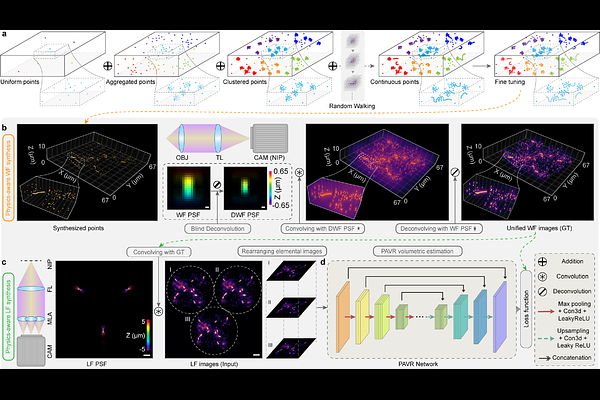
AbstractThe rapid convergence of advanced microscopy and deep learning is transforming cell biology by enabling imaging systems in which optical encoding and computational inference are jointly optimized for volumetric information capture and interpretation. However, broadly accessible three-dimensional imaging at high spatiotemporal resolution remains constrained by volumetric reconstruction throughput, susceptibility to artifacts, and the burden of collecting modality-matched training data. Here, we introduce PAVR, a physics-aware light-field imaging platform that integrates single-shot volumetric acquisition with fast, end-to-end volumetric reconstruction. PAVR is trained entirely using in silico system responses, avoiding reliance on external high-resolution ground-truth modalities and enabling sample-independent reconstruction across diverse biological contexts. Using fixed and live mammalian cells, we demonstrate multicolor volumetric imaging of subcellular organelles, three-dimensional tracking of autofluorescent particles, and high-speed visualization of organelle remodeling and interactions. We further extend PAVR to quantify coupled morphological and functional dynamics in beating human induced pluripotent stem cell-derived cardiomyocytes under pharmacological perturbation. Together, PAVR establishes a scalable hardware-software platform for high-throughput volumetric imaging and quantitative analysis of dynamic cellular systems in both basic and translational settings.