New perspectives in assessing environmental risks for birds: a simple TKTD framework to link growth and reproduction energy budget to chemical stress

New perspectives in assessing environmental risks for birds: a simple TKTD framework to link growth and reproduction energy budget to chemical stress
Baudrot, V.; Kaag, M.; Charles, S.
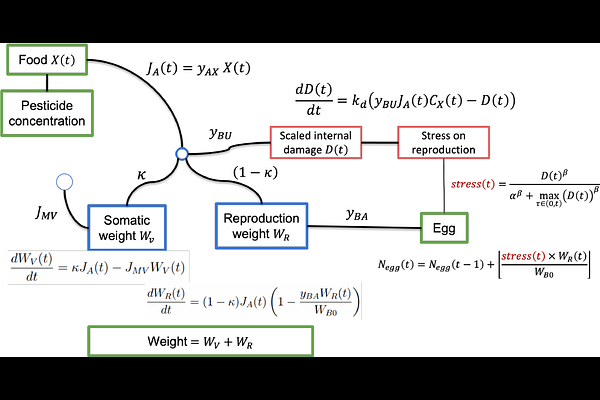
AbstractAssessing the risk of pesticides to birds requires models that can extrapolate laboratory data to realistic exposure scenarios. In this work, we propose a new modeling framework BIRDkiss (Bird - Impact on Reproduction via Diet, keep it simple and suitable) that accounts for both a simplified Dynamic Energy Budget (DEBkiss) of organisms and the toxicokinetic-toxicodynamic (TKTD) of chemical substances according to a trait-based approach, thereby reducing the number of parameters to identify and strengthening the statistical robustness of the critical endpoints. The BIRDkiss model describes how food intake and toxicant exposure affect growth and egg production in birds over time. The model is fully embedded within an R package, including routines for calibration, validation and prediction under single-compound scenarios performed via Bayesian inference using standard data from the OECD avian reproduction tests. The BIRDkiss model also allows the simulations of scenarios under both varying food availability and multi-compound exposures based on the two classical mixture-toxicity paradigms: Concentration Addition (CA) and Independent Action (IA). The results of calibration for single compounds show good results matching with observed weights and egg counts. From these calibrations, predictions for new exposure scenarios can be readily generated. For mixtures, the IA algorithm is simpler and does not require to scale variables as in CA. Simulations indicate that high food levels do not further increase egg production (saturation), whereas substantial food reductions markedly decrease reproduction because energy is reallocated to maintenance. Exposure to chemicals combined to low food availability amplify the decline in reproductive output. The ready-to-use mechanistic, open-source BIRDkiss tool enables predicting the impact of pesticides on avian reproduction under realistic dietary exposure profiles. The implementation of CA and IA models is a first step toward mechanistic assessment of chemical mixtures, although validation still requires empirical mixture data. The model highlights the importance of food availability and shows that chemical stress can exacerbate the negative effects of nutritional stress. Integrating such models into regulatory frameworks could improve the ecological relevance of risk assessments.