The transmembrane protein TMEM127 regulates activation and fate of an MHC-I degradation complex by WWP2 modifications

The transmembrane protein TMEM127 regulates activation and fate of an MHC-I degradation complex by WWP2 modifications
Gonzalez-Cantu, H.; Nascimento da Conceicao, V.; Munawar, S. Y.; Johns, K.; Jaafar, C.; Reyna, N.; Multani, A.; Estrada-Zuniga, C. M.; Zhou, D.; Aguiar, R. C. T.; Yuan, Y.; Dahia, P. L. M.
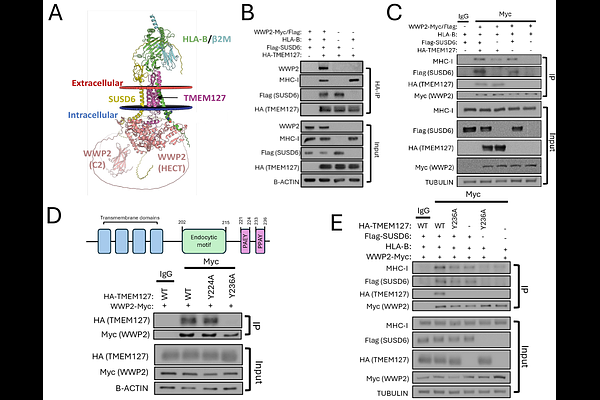
AbstractTMEM127 is an adaptor protein that bridges substrates to E3 ubiquitin ligases of the HECT family. Among its interacting partners is the major histocompatibility class I (MHC-I), a critical component of the antigen presentation pathway and the adaptive immune response. MHC-I is ubiquitinated and fated for lysosome-mediated degradation by the WWP2 E3 ligase in a complex that involves TMEM127 and a second adaptor protein, SUSD6. However, the interacting dynamics among complex components remains to be determined, a key knowledge gap towards the development of pharmacological modulators. Here, using in vitro and in vivo models, we report that TMEM127-WWP2 interaction stabilizes the MHC-I degradation complex and reveals an asymmetric role of the two adaptor proteins. Specifically, we find that TMEM127 regulates WWP2 catalytic activity, abundance and localization through its canonical PY motif interaction with the WW domain of WWP2 with contribution of a TMEM127 endocytic motif, providing a mechanism to restrain complex activity. Further, we validate the impact of TMEM127 dosage in the endogenous complex assembly and regulation. Our results nominate TMEM127 as a critical member of the MHC-I degradation complex and highlight the TMEM127-WWP2 interaction as a target for augmenting MHC-I-mediated antigen presentation, a long sought goal in cancer immunology.