ORC binding to Heterochromatin Protein 1 through intrinsically disordered regions is required for heterochromatin structure and function

ORC binding to Heterochromatin Protein 1 through intrinsically disordered regions is required for heterochromatin structure and function
Luo, Y.; Rajshekar, S.; Kumar, H.; Berger, J. M.; Karpen, G.; Botchan, M.
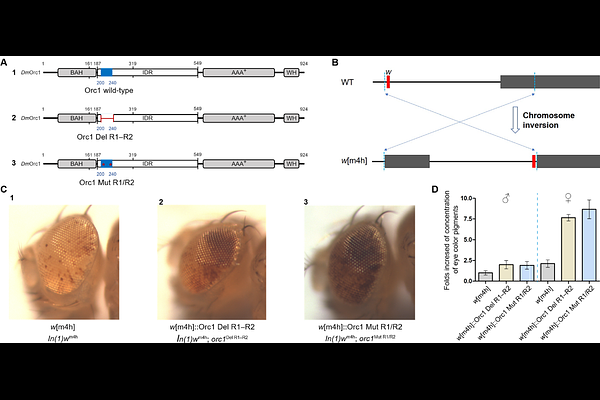
AbstractThe Origin Recognition Complex (ORC) is known for initiating DNA replication in eukaryotic cells, but increasing evidence suggests that ORC has multiple functions. Here we show that the organization and function of two major nuclear components, heterochromatin and the nucleolus, depend on multivalent interactions between Orc1 and Heterochromatin Protein 1a (HP1a) in Drosophila melanogaster. Specifically, binding requires two short motifs (R1 and R2) in the intrinsically disordered region (IDR) of Orc1, and two motifs (HGM and CTE) located in the N- and C-terminal regions of HP1a. Pairing of these four motifs promotes ORC-HP1 interactions, which also requires HP1 dimerization. Disrupting ORC-HP1a interactions by mutating the R1/R2 motifs causes defects in heterochromatin functions, specifically suppression of Position-Effect Variegation (PEV), ribosomal DNA (rDNA) decondensation, increased rRNA transcription, and nucleolar expansion, without global loss of H3K9me2 epigenetic modifications. Our findings indicate that ORC acts as a structural regulator that organizes heterochromatic regions and promotes proper genome regulation through multivalent interactions with HP1 and chromatin.