Experimental Evolution of Yeast Reveals Trade-offs Between Early and Late Stationary Phase

Experimental Evolution of Yeast Reveals Trade-offs Between Early and Late Stationary Phase
Tarkington, J. A.; Sherlock, G. J.; Mahadevan, A.
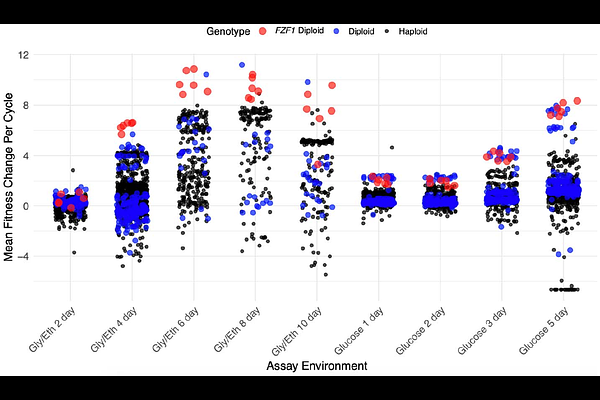
AbstractStationary phase in yeast and other microorganisms begins when a limiting nutrient in the environment is exhausted and cell division ceases. Most cells subsequently enter quiescence and lose viability. In spent media, without metabolic byproducts being diluted, cellular processes can modify the environment and cause the relative growth rates of different genotypes to vary over the course of stationary phase. In this work we experimentally evolve S. cerevisiae in batch culture, varying the time spent in stationary phase between growth cycles. We measure the relative fitness of the resulting adaptive clones across a range of environments: with different amounts of time in stationary phase and in two different carbon sources. By comparing the inferred performance (relative growth rate during a period of the growth cycle) of a mutant to that of its ancestor, we can estimate the effects of each observed mutation on performance during various phases of growth. We show that when an adaptive mutation emerges in growth cycles that include a stationary phase, its effect on stationary phase performance is largely independent of the type of carbon source provided. However, for the same group of mutants, mutational effects on performance in early stationary phase are negatively correlated with those effects in late stationary phase, suggesting a trade-off. We also show that increased intervals of stationary phase result in larger fitness effects of adaptive mutations and distinct routes of adaptation. Together, these results demonstrate that stationary phase consists of more than one distinct fitness-related phenotype, and that the phenotypes that allow for high performance in the first few days of stationary phase trade off with those that allow for high performance in later stationary phase.