Interaction-powered Type Ibn Supernovae as a Transient PeVatron Candidate: The Case of SN 2023uqf

Interaction-powered Type Ibn Supernovae as a Transient PeVatron Candidate: The Case of SN 2023uqf
Ryo Sawada, Yusuke Inoue, Yosuke Ashida
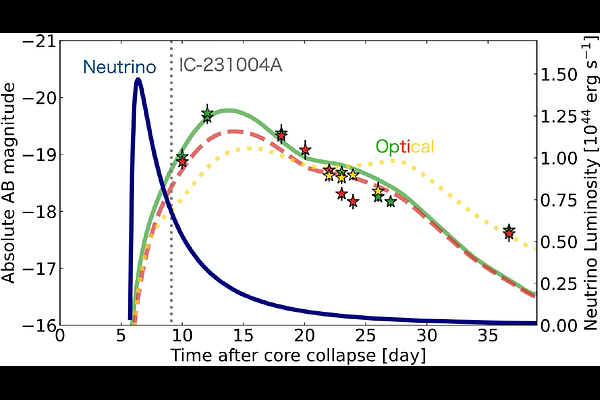
AbstractWe investigate whether the Type Ibn supernova SN 2023uqf, reported close in time and direction to the $\sim$442 TeV IceCube alert IC-231004A, is physically consistent with a shock--circumstellar medium (CSM) interaction scenario. One-dimensional radiation-hydrodynamics calculations with {\tt STELLA} reproduce the ZTF optical light curves with a dense helium-rich CSM following $ρ_\mathrm{CSM} \propto r^{-3}$ and a CSM density parameter $D'\approx 50$. Using the shock evolution and CSM conditions inferred from the optical data, we model time-dependent cosmic-ray acceleration and hadronic neutrino production during the interaction phase. The inferred shock and CSM properties open a short-lived window in which multi-PeV hadron acceleration and efficient hadronic interactions can coexist, making SN 2023uqf a plausible transient PeVatron candidate. After folding the predicted neutrino emission through the IceCube effective area, we obtain an expected number of $\sim10^{-5}-10^{-4}$ track-like events at $d = 723$ Mpc, depending on the alert selection. In the low-count regime, the model predicts a detection-time weighting for a rare event, and the detection time of IC-231004A falls within the high-weight interval while its energy scale is compatible with the modeled spectrum. Although a single event cannot establish a definitive association, our results show that the optically inferred environment of SN 2023uqf is consistent with a transient PeVatron window and illustrate how interaction-powered Type Ibn supernovae can be tested as high-energy neutrino sources.