Explicitly nonlinear fMRI networks reveal hidden trajectories of infant brain development

Explicitly nonlinear fMRI networks reveal hidden trajectories of infant brain development
Kinsey, S. E.; Nagaboina, G.; Bajracharya, P.; Seraji, M.; Fu, Z.; Calhoun, V. D.; Shultz, S.; Iraji, A.
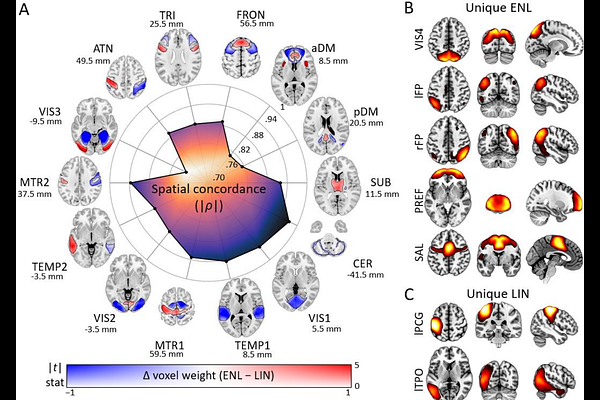
AbstractNonlinearity is a hallmark of brain complexity at multiple scales. However, existing functional magnetic resonance imaging (fMRI) functional connectivity studies typically utilize linear methods. Therefore, links between nonlinear fMRI connectivity patterns and the development of the human brain during critical periods such as infancy remain unclear. To address this gap in knowledge, we developed a data-driven approach to capture brain intrinsic connectivity networks from explicitly nonlinear resting-state fMRI connectivity and profiled their developmental associations in a cohort of typically developing human infants. We identified neurobiologically structured nonlinear fMRI connectivity patterns during early postnatal life, indicating that macroscopic brain ensembles systematically participate in nonlinear relationships at birth. Furthermore, we found that linear and explicitly nonlinear network counterparts are linked to partially overlapping but complementary developmental profiles during this period of rapid brain maturation, with the explicitly nonlinear approach unveiling insights into the development of networks that have been associated with sensorimotor capacities, default mode processes, executive functioning, language production, and stimulus saliency. Our study marks the first comprehensive developmental investigation of whole-brain nonlinear fMRI networks in human infants and deepens contemporary perspectives on neuroimaging data discovery by emphasizing the informational richness of nonlinear relationships at fMRI scales of observation.