Integration of iPSC-derived microglia into human midbrain organoids enhances microglial maturation and inflammatory signaling

Integration of iPSC-derived microglia into human midbrain organoids enhances microglial maturation and inflammatory signaling
MacDougall, E. J.; Deyab, G.; Ormancey, A.; Li, J.; Goldsmith, T. M.; Lepine, P.; Baeza Trallero, M.; Finkel, N.; Sirois, J.; Berryer, M. H.; Durcan, T.; Fon, E. A.
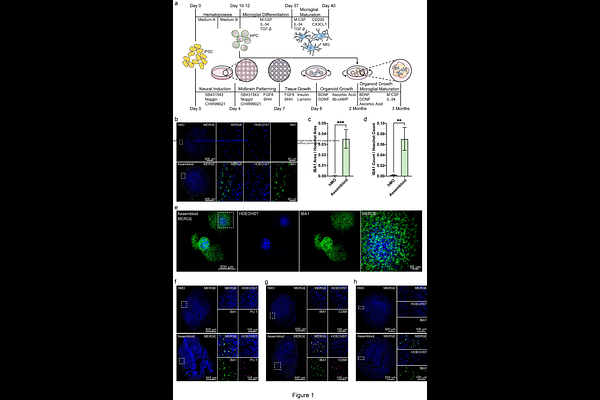
AbstractMicroglia are the resident immune cells of the central nervous system and play key roles in the healthy brain during development and adulthood, as well as during neurodegenerative diseases - including Parkinson's disease (PD). Yet the role of microglia in PD pathogenesis has not been fully elucidated. Limitations of 2D cell culture and animal models in simulating human microglia in the brain parenchyma have contributed to this knowledge gap. Human midbrain organoids (hMOs) provide a promising model that can recapitulate elements of PD pathology but lack microglial cells. Here we adapt protocols for the differentiation of hMOs and human iPSC-derived microglia (iMG) to generate iMG-hMO assembloids. Within assembloids, integrated iMG (intMG) express canonical microglia markers and induce the release of cytokines and chemokines. Transcriptomic profiling by single cell RNA sequencing reveals that intMG adopt a more mature and inflammation-responsive state compared to 2D iMG. The integration of microglia results in increased signaling through inflammatory and trophic pathways that drive altered transcriptional signatures of dopaminergic neurons and astrocytes within assembloids. Overall, iMG-hMO assembloids have the potential to more faithfully model the role of microglia and neuroinflammation in PD pathogenesis.