Independence of Visuomotor Functions Engaged in Visual Pursuit and Rapid Responses to Reach Errors

Independence of Visuomotor Functions Engaged in Visual Pursuit and Rapid Responses to Reach Errors
Moraes, R.; Fooken, J.; Flanagan, J. R.
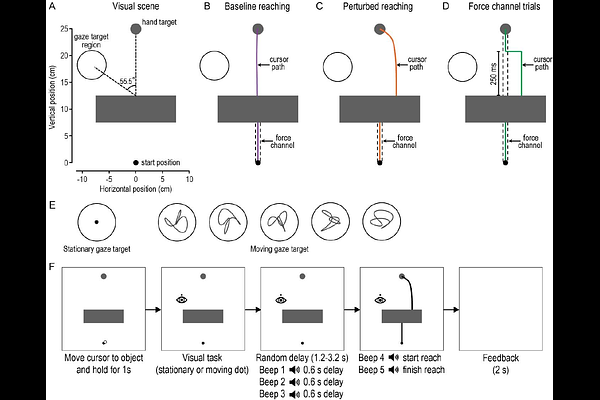
AbstractWhen reaching to a foveated target, peripheral vision of the hand can be used to make rapid, automatic adjustments to the ongoing reach movement, with the feedback gain being sensitive to features of the task and environment. These rapid corrective responses are also observed when gaze is directed to a stationary "gaze" target located away from the reach target. In everyday contexts, reaching often occurs concurrently with other visual or visuomotor tasks, such as tracking a moving target. Yet it remains unclear whether engaging in such tasks affects the use of peripheral vision for hand guidance. Here, we compare rapid visuomotor corrective responses to visual perturbations during fixation and smooth pursuit, and test whether pursuit-related and reach-related visuomotor processes operate independently or compete for shared visual resources. Participants either fixated a stationary target or tracked a moving target while reaching toward a spatially dissociated reach target. During the reach, the visual representation of the hand was perturbed, requiring rapid corrective responses. We found that neither the onset nor the gain of reach corrections was modulated by gaze-task demands. Moreover, response gains were strongly correlated across tasks, indicating consistent individual response profiles that were independent of the gaze condition. Despite modest increases in position error and decreases in gain, participants largely sustained engagement with the visual tasks during target reaching. These findings demonstrate that smooth pursuit and reach-related visuomotor processing can operate in parallel without mutual interference, suggesting a functional independence between them.