The mammalian muscle spindle as a tunable feedback controller in locomotion

The mammalian muscle spindle as a tunable feedback controller in locomotion
Simha, S. N.; Sawicki, G. S.; Cope, T. C.; Ting, L. H.
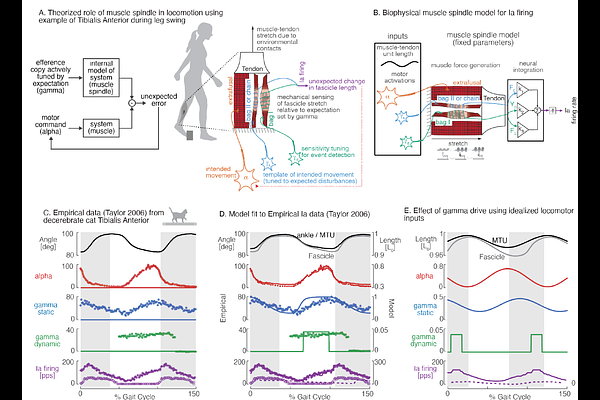
AbstractAlthough muscle spindle sensory signals have been extensively studied, little is known about how and why muscle spindle firing is modulated by the central nervous system during movement. Specialized motor neurons to the muscle spindle, i.e. gamma motor neurons, can profoundly alter spindle firing during behavior, but technological limitations hinder our ability to record gamma motor and muscle spindle sensory signals during most behaviors. We used a biophysical model of a muscle spindle within a muscle-tendon unit to simulate how gamma drive may modulate muscle spindle Ia firing during locomotion. Based on a few available recordings from decerebrate animals, we demonstrate that our model, tuned to passive stretch conditions, can reproduce profound changes in muscle spindle firing in response to identical joint motions in locomotor vs. relaxed stretch conditions. Our model can discover phasic patterns of two types of gamma motor neuron drive based on recorded muscle spindle Ia firing and joint motion. By simulating perturbations, we conclude that: 1) sinusoidal activation of static gamma motor neurons during locomotion, encoding intended movement, modulates muscle spindle signals such that they act as sensorimotor feedback signals based on errors from the intended muscle fascicle length; 2) phasic on/off activation of dynamic gamma motor neurons during locomotion acts as an event detector, heightening muscle spindle Ia responses to discrete perturbations. As such, their muscle-within-muscle structure allows the muscle spindle to act as a highly tunable physical internal model of muscle state to guide movement. Our model supports proposed but as-yet-untested theories of muscle spindle function and offers a framework for extending the testing of muscle spindle function to active, behavioral conditions.