The phylogenetic signal in primate ontogenies, with special attention to dental development

The phylogenetic signal in primate ontogenies, with special attention to dental development
Cerrito, P.
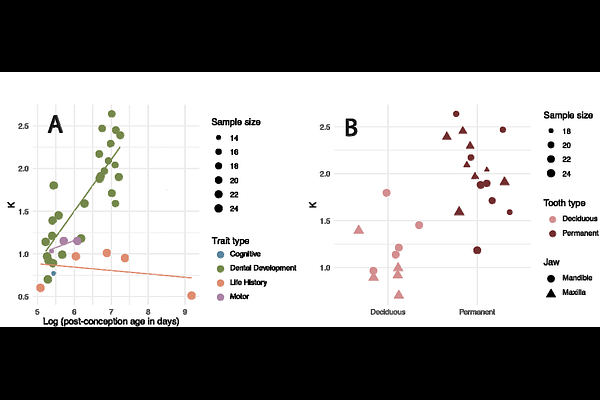
AbstractComparative studies in evolutionary biology must account for trait non-independence arising from shared ancestry. While the phylogenetic signal of adult traits has been extensively studied, little is known about how conserved developmental trajectories are across species. Here, I quantify the phylogenetic signal (K) in the ontogeny of 35 traits across 157 primate species, spanning motor, cognitive, life-history, and dental development. Using Blomberg's K statistic and a species-level mammalian phylogeny, I test two predictions: (i) that morphological (dental) traits exhibit the strongest phylogenetic signal, and (ii) that earlier-developing traits are more conserved. Results show that life-history traits are the most phylogenetically labile, while dental development is the most conserved (K = 0.7-2.6), with the eruption of the mandibular canine showing the highest signal (K = 2.6). Contrary to expectations, later-developing traits, particularly permanent teeth, display stronger phylogenetic conservation than earlier-developing deciduous teeth. These findings suggest that even within a single developmental system, the strength of phylogenetic constraint varies markedly with timing. The results provide an empirical foundation for identifying reliable temporal anchors in comparative primate ontogeny and have implications for interpreting maturational patterns in human evolution and the fossil record.