Fluctuation-induced symmetry breaking in high harmonic generation for bicircular quantum light
0upvotes
By: Philipp Stammer, Camilo Granados, Javier Rivera-Dean
Symmetries are ubiquitous in physics and play a pivotal role in light-matter interactions, where they determine the selection rules governing allowed atomic transitions and define the associated conserved quantities. For the up-conversion process of high harmonic generation, the symmetries of the driving field determine the allowed frequencies and the polarization properties of the resulting harmonics. As a consequence, it is possible to esta... more
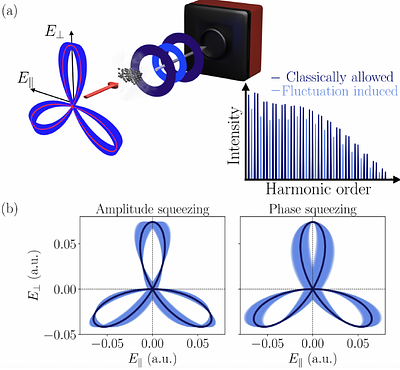
Symmetries are ubiquitous in physics and play a pivotal role in light-matter interactions, where they determine the selection rules governing allowed atomic transitions and define the associated conserved quantities. For the up-conversion process of high harmonic generation, the symmetries of the driving field determine the allowed frequencies and the polarization properties of the resulting harmonics. As a consequence, it is possible to establish classical selection rules when the process is driven by coherent radiation. In this work, we show that fluctuation-induced symmetry breaking in the driving field leads to the appearance of otherwise forbidden harmonics. This is achieved by considering bicircular quantum light, and demonstrate that the enhanced quantum fluctuations due to squeezing in the driving field break the classical selection rules. To this end, we develop a quantum optical description of the dynamical symmetries in the process of high harmonic generation, revealing corrections to the classical selection rules. Moreover, we show that the new harmonics show squeezing-like signatures in their photon statistics, allowing them to be clearly distinguished from classical thermal fluctuations. less
By: Shival Dasu, Ben Criger
We provide a recursively defined sequence of flag circuits which will detect logical errors induced by non-fault-tolerant $R_{\overline{Z}}(\fracπ{2^l})$ gates on CSS codes with a fault distance of two. As applications, we give a family of circuits with $O(l)$ gates and ancillae which implement fault-tolerant logical $R_{Z}(\fracπ{2^l})$ or $R_{ZZ}(\fracπ{2^l})$ gates on any $[[k + 2, k, 2]]$ iceberg code and fault-tolerant circuits of size $... more
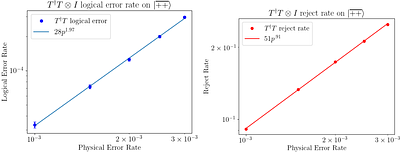
We provide a recursively defined sequence of flag circuits which will detect logical errors induced by non-fault-tolerant $R_{\overline{Z}}(\fracπ{2^l})$ gates on CSS codes with a fault distance of two. As applications, we give a family of circuits with $O(l)$ gates and ancillae which implement fault-tolerant logical $R_{Z}(\fracπ{2^l})$ or $R_{ZZ}(\fracπ{2^l})$ gates on any $[[k + 2, k, 2]]$ iceberg code and fault-tolerant circuits of size $O(l)$ for preparing $|\fracπ{2^l}\rangle$ resource states in the $[[7,1,3]]$ code, which can be used to perform fault-tolerant $R_{\overline{Z}}(\fracπ{2^l})$ rotations via gate teleportation, allowing for implementations of these gates that bypass the high overheads of gate synthesis when $l$ is small relative to the precision required. We show how the circuits above can be generalized to $π( x_0.x_{1}x_{2}\ldots x_{l}) = \sum_{j}^{l} π\frac{x_j}{2^j}$ rotations with identical overheads in $l$, which could be useful in quantum simulations where time is digitized in binary. Finally, we illustrate two approaches to increase the fault-distance of our construction. We show how to increase the fault distance of a Cliffordized version of the T gate circuit to $3$ in the Steane code and how to increase the fault-distance of the $\fracπ{2}$ iceberg circuit to $4$ through concatenation in two-level iceberg codes. This yields a targeted logical $R_{\overline{Z}}(\fracπ{2})$ gate with fault distance $4$ on any row of logical qubits in an $[[(k_2+2)(k_1+2), k_1k_2, 4]]$ code. less
By: Kenta Kasai
We construct nested Calderbank-Shor-Steane code pairs with non-vanishing coding rate from Hsu-Anastasopoulos codes and MacKay-Neal codes. In the fixed-degree regime, we prove relative linear distance with high probability. Moreover, for several finite degree settings, we prove Gilbert-Varshamov distance by a rigorous computer-assisted proof.
We construct nested Calderbank-Shor-Steane code pairs with non-vanishing coding rate from Hsu-Anastasopoulos codes and MacKay-Neal codes. In the fixed-degree regime, we prove relative linear distance with high probability. Moreover, for several finite degree settings, we prove Gilbert-Varshamov distance by a rigorous computer-assisted proof. less
By: Sooryansh Asthana, Conan Alexander, Anubhav Kumar Srivastava, T. S. Mahesh, Sai Vinjanampathy
Quantum probes that enable enhanced exploration and characterization of complex systems are central to modern science, spanning applications from biology to astrophysics and chemical design. In large many-body quantum systems, interactions delocalize phase information across many degrees of freedom, dispersing it away from accessible measurements and limiting the scalability of quantum metrology. Here we show that experimentally accessible Cl... more
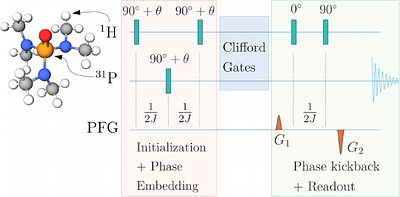
Quantum probes that enable enhanced exploration and characterization of complex systems are central to modern science, spanning applications from biology to astrophysics and chemical design. In large many-body quantum systems, interactions delocalize phase information across many degrees of freedom, dispersing it away from accessible measurements and limiting the scalability of quantum metrology. Here we show that experimentally accessible Clifford operations acting jointly on quantum states and observables can refocus this distributed information. These operations implement what we term {\it Clifford lensing}--transformations that coherently localize phase information onto a reduced set of degrees of freedom, mapping optimal measurements onto observables of reduced Pauli weight. We establish a correspondence between quantum error-correcting codes and interferometric constructions that enforce deterministic phase kickback, and generalize this to circuits that concentrate many-body phase information onto a controllable subset of qubits. We further develop partial shadow tomography protocols for estimating subsystem-supported phases. We experimentally demonstrate these principles in liquid-state nuclear magnetic resonance systems of up to fifteen qubits, achieving optimal sensing with constrained resources. Our results establish a scalable route to coherent control of information flow in interacting quantum systems, enabling many-body quantum sensing and multimode interferometry across complex architectures. less
By: Hugo Perrin, Gatien Roger, Guido Pupillo
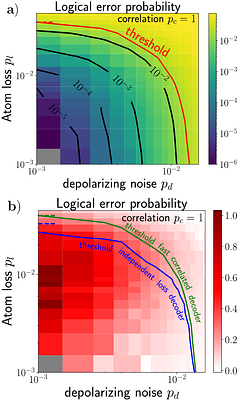
Atom loss is a dominant error source in neutral-atom quantum processors, yet its correlated structure remains largely unexploited by existing quantum error correction decoders. We analyze the performance of the surface code equipped with teleportation-based loss-detection units for neutral-atom quantum processors subject to circuit-level, partially correlated atom loss and depolarizing noise. We introduce and implement a decoding strategy tha... more
Atom loss is a dominant error source in neutral-atom quantum processors, yet its correlated structure remains largely unexploited by existing quantum error correction decoders. We analyze the performance of the surface code equipped with teleportation-based loss-detection units for neutral-atom quantum processors subject to circuit-level, partially correlated atom loss and depolarizing noise. We introduce and implement a decoding strategy that exploits loss correlations, effectively converting the \textit{delayed} erasure channels stemming from atom loss to erasure channels. The decoder constructs a loss graph and dynamically updates loss probabilities, a procedure that is highly parallelizable and compatible with real-time operation. Compared to a decoder that assumes independent loss events, our approach achieves up to an order-of-magnitude reduction in logical error probability and increases the loss threshold from $3.2\%$ to $4\%$. Our approach extends to experimentally relevant regimes with partially correlated loss, demonstrating robust gains beyond the idealized fully correlated setting. less
6 SciCasts by .