Assessing the Impact of Varying HSO Cross Sections on Photochemical Models: Implications for the Spectral Characterization of Terrestrial Exoplanets

Assessing the Impact of Varying HSO Cross Sections on Photochemical Models: Implications for the Spectral Characterization of Terrestrial Exoplanets
Alexandre Branco, Clara Sousa-Silva, Wynter Broussard, Edward W. Schwieterman, Sukrit Ranjan, Vera Topcik, Olivier D. S. Demangeon, Pedro Machado
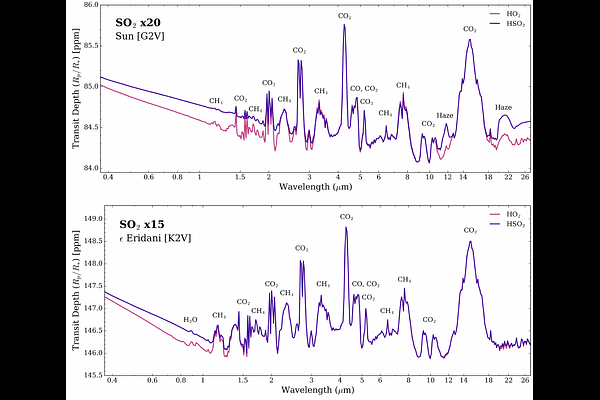
AbstractCharacterization of exoplanet atmospheres requires a close interplay between observations, modelling and experimental data. The accuracy of input data used in atmospheric models is essential, as it impacts our interpretation of planetary spectra with retrieval codes. Molecular absorption cross sections in the Ultraviolet-Visible range are fundamental input parameters, determining chemical kinetics, particularly on temperate terrestrial planets. However, several atmospheric species remain poorly, or even entirely uncharacterised. This is the case for HSO, a radical with unconstrained photolysis cross sections, often approximated by hydroperoxyl (HO2). Sulphur chemistry can strongly influence the composition of rocky exoplanets, particularly in anoxic environments where volcanic SO2 -- the main source of HSO -- is more efficiently photolysed, and sulphur aerosols like S8 can form. HSO photolysis contributes to the formation of such sulphur chains, which have been proposed as indirect signatures of volcanic outgassing. Assessing the sensitivity of photochemical models to different UV-Visible cross-section prescriptions for HSO is therefore important for guiding its prioritization among poorly characterised atmospheric species. Here, we derive an updated HSO cross-section prescription from simulated HSO2 data, providing a more reliable representation of HSO photolysis than HO2. We compare results from these new cross sections to the default prescription for temperate terrestrial planets with Archean-like atmospheres. We find that our updated HSO cross-section prescription enhances aerosol scattering and absorption signatures in transmission, emission and reflection spectra for planets orbiting G- and K-type stars.