Design and Forecasts for a Rubin Twilight Program for Nearby Type Ia Supernovae

Design and Forecasts for a Rubin Twilight Program for Nearby Type Ia Supernovae
Xianzhe TZ Tang, Dillon Brout, Christopher W. Stubbs, Elana K. Urbach, J. Bryce Kalmbach, Greg Aldering, Bastien Carreres, Chris Frohmaier, Ayan Mitra, Erik R. Peterson, Corentin Ravoux, the LSST Dark Energy Science Collaboration
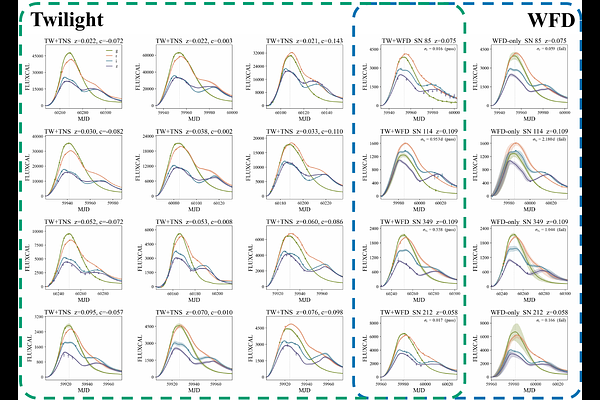
AbstractNearby Type Ia supernovae (SNe Ia) are important for supernova cosmology, but saturation in 30 s exposures, gaps in light-curve sampling, and the footprint of Vera C. Rubin Observatory's baseline Wide-Fast-Deep (WFD) survey limit the nearby sample. To improve the low-$z$ sample, we propose a twilight follow-up program using Rubin Observatory for 1-5 s griz exposures at solar altitudes $-12^\circ \le \mathrm{Alt}_\odot \le -9^\circ$. Using simulations of one year of WFD observations, we find that twilight follow-up adds 230 quality-selected SNe Ia from an external sample drawn primarily from the Transient Name Server (TNS). At $z<0.08$, the usable sample increases from 368 to 643 SNe Ia, including 50 WFD events recovered by refitting their light curves with twilight photometry. Combining these twilight observations with high-redshift WFD and Deep Drilling Field samples increases the statistical-only dark-energy $(w_0,w_a)$ figure of merit from 49.3 to 58.3 (18%) and reduces $σ(w_a)$ by 10%. For measurements of structure growth at $0.02 \le z<0.06$, the fractional uncertainty on $fσ_8$ decreases from 0.783 to 0.305. Restricting the program to $-12^\circ \le \mathrm{Alt}_\odot \le -11^\circ$ reduces the dark-energy improvement to 7.2%. These short exposures could also provide unsaturated photometry of potential distance-ladder calibrators at $z<0.02$.