Microlensing Black Hole Shadows-II: Constraining Primordial Black Hole Dark Matter using the photon rings of M87 and Sgr A*

Microlensing Black Hole Shadows-II: Constraining Primordial Black Hole Dark Matter using the photon rings of M87 and Sgr A*
Himanshu Verma, Priyanka Sarmah, Joseph Silk, Kingman Cheung
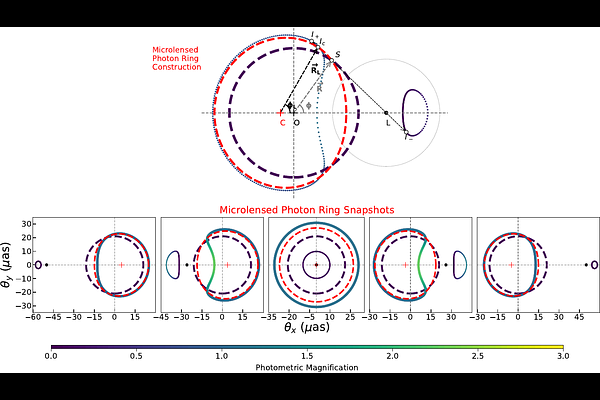
AbstractThe resolution of photon rings of Sgr~A$^*$ and M87 is the next milestone of upcoming EHT-like interferometries. We extend the formalism developed in our previous work~\cite{Verma:2023hes} to constrain primordial black hole (PBH) dark matter using microlensing-induced distortions of black hole shadows. Building upon the theoretical framework for microlensing of photon rings, we apply this methodology to both Sgr A* and M87, considering multiple PBH populations: (i) PBH dark matter spikes around central supermassive black holes, (ii) NFW halo contributions in the Milky Way and M87 galaxies, and (iii) foreground Milky Way PBH dark matter affecting M87* observations. The microlensing signal manifests as a time-dependent asymmetry and deformation of the photon ring, providing the most sensitive observable for lensing effects. We assess the detectability of these signatures with future EHT-like interferometers. Our analysis reveals that M87* provides the strongest constraints on PBH dark matter. We show that the absence of photon-ring asymmetries in observations with angular resolution of order $0.1\,μ{\rm as}$ can constrain PBHs in the mass range $10^{-5}\,M_\odot \lesssim M_{\rm PBH} \lesssim 10^{6}\,M_\odot$, with maximal sensitivity near $M_{\rm PBH}\sim10^{3}\,M_\odot$, for PBH dark matter fractions as small as $f_{\rm PBH}\sim10^{-2}$.