Characterizing Photonic Ring Resonator Filters for OH Suppressed Near-infrared Astronomy

Characterizing Photonic Ring Resonator Filters for OH Suppressed Near-infrared Astronomy
A. Hermann, J. Lasker, R. Vaisakh, R. Kehoe, R. Staten, A. Wallace, S. Ellis, K. Kuehn, S. Kuhlmann
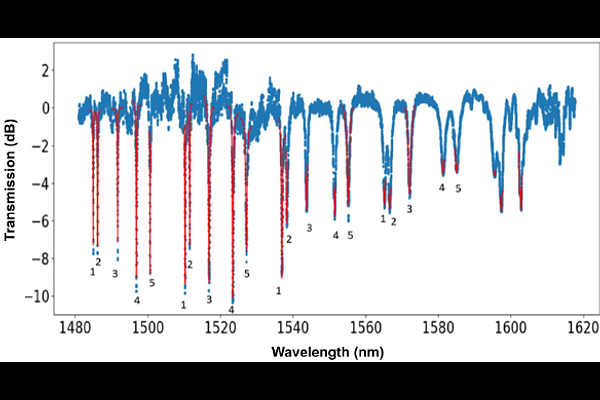
AbstractSupernova cosmology relies on accurate measurement of the absolute magnitudes of Type Ia supernovae. Observation in the visible incurs significant systematic uncertainties in these measurements due to their high degree of interstellar dust extinction. Observing in the near-infrared (750-2500 nm) mitigates this issue by decreasing attenuation, decreasing dispersion, and increasing supernova observation distances. However, ground-based observations in the near-infrared suffer from sky background caused by atmospheric OH emission lines. Advancements in photonic ring resonator filter devices make it feasible to suppress these lines. In this paper, we evaluate the performance of a prototype photonic ring resonator device developed for use in the lower H-band (1480-1620 nm). Specifically, we characterize the progression of suppressed wavelengths into the upper H-band (1620-1800 nm) enabling the suppression of emission lines over a broader wavelength range.