Emulation of non-linear 1D spectral models: relativistic X-ray reflection

Emulation of non-linear 1D spectral models: relativistic X-ray reflection
Benjamin J. Ricketts, Tin Hadži Veljković, Daniela Huppenkothen, Adam Ingram, Matteo Lucchini, Guglielmo Mastroserio, Fergus J. E. Baker
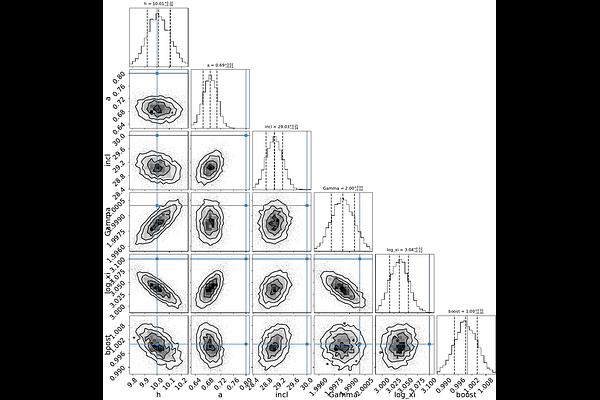
AbstractThe use of machine learning techniques to approximate computationally expensive models has become increasingly prevalent in a wide variety of fields within astronomy. We discuss the implementation of emulators for 1-dimensional models in the context of the astrophysical numerical model reltrans, a black hole X-ray spectral model that models the effects of relativistically smeared emission from an accretion disk. We argue that the decision of whether and how to emulate should follow from a systematic characterisation of the target model, and we demonstrate a diagnostic workflow: examining how the spectrum varies with individual parameters. We adopt a modular strategy, emulating only the relativistically convolved reflection spectrum (1-10% of the total flux) rather than the full model. Using an operator-learning architecture with Fourier feature embeddings and FiLM conditioning, we reproduce the reflection spectrum to O(0.1)% precision across 0.1-100 keV with a 4-10x speed-up that scales considerably better under vectorised evaluation. This emulator, RTFAST2, recovers the true parameters of simulated observations without the systematic posterior biases of our previous work. We conclude that no architecture is universally transferable and bespoke emulators motivated by a model's specific structure are required. The modular approach taken in this work presents a promising strategy for future emulators of numerical models.