Four Generations of Quantum Biomedical Sensors

Four Generations of Quantum Biomedical Sensors
Xin Jin, Priyam Srivastava, Ronghe Wang, Yuqing Li, Jonathan Beaumariage, Tom Purdy, M. V. Gurudev Dutt, Kang Kim, Kaushik Seshadreesan, Junyu Liu
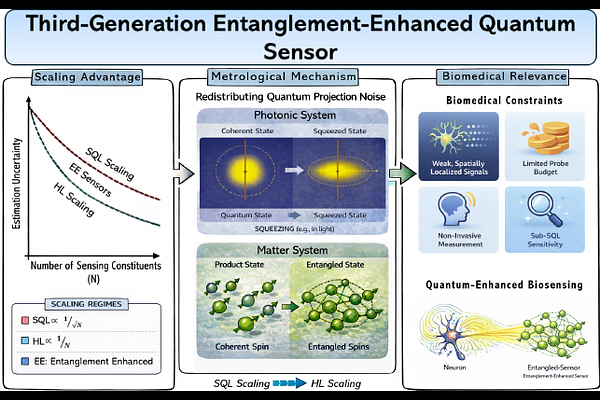
AbstractQuantum sensing technologies offer transformative potential for ultra-sensitive biomedical sensing, yet their clinical translation remains constrained by classical noise limits and a reliance on macroscopic ensembles. We propose a unifying generational framework to organize the evolving landscape of quantum biosensors based on their utilization of quantum resources. First-generation devices utilize discrete energy levels for signal transduction but follow classical scaling laws. Second-generation sensors exploit quantum coherence to reach the standard quantum limit, while third-generation architectures leverage entanglement and spin squeezing to approach Heisenberg-limited precision. We further define an emerging fourth generation characterized by the end-to-end integration of quantum sensing with quantum learning and variational circuits, enabling adaptive inference directly within the quantum domain. By analyzing critical parameters such as bandwidth matching and sensor-tissue proximity, we identify key technological bottlenecks and propose a roadmap for transitioning from measuring physical observables to extracting structured biological information with quantum-enhanced intelligence.