Circuit Modeling for In Situ 21 cm Radiometer Calibration

Circuit Modeling for In Situ 21 cm Radiometer Calibration
Gary Vincent Charles Allen, Saurabh Pegwal, Dirk de Villiers, Dominic Anstey, Kaan Artuc, Harry Bevins, Gianni Bernardi, Martin Bucher, Steve Carey, Jean Cavillot, Ricardo Chiello, Adele Chu, Wessel Croukamp, John Cumner, Ardash Dash, Saswata Dasgupta, Eloy de Lera Acedo, Jiten Dhandha, Aleksandra Dragovic, John Ely, Anastasia Fialkov, Thomas Gessey-Jones, Will Handley, Christian Kirkham, Girish Kulkarny, Samuel Leeney, Alessio Magro, Daan Meerburg, Shikhar Mittal, Daniel Molnar, Rohan Patel, Joe Pattison, Carla Pieterse, Jonathan Pritchard, Gabriella Rajpoot, Nima Razavi-Ghods, Daniel Robins, Ian Roque, Anchal Saxena, Killian Scheutwinkel, Paul Scott, Emma Shen, Peter Sims, Marta Spinelli, Jiacong Zhu
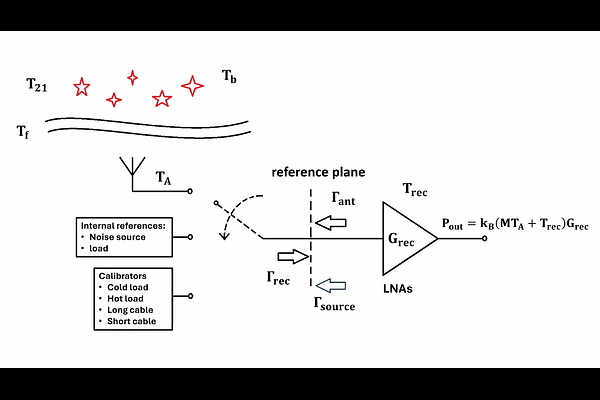
AbstractRecent experiments in cosmology, particularly those aimed at detecting the faint, redshifted, global 21 cm hydrogen line (depth < ~200 mK, z > 7.5), have imposed stringent new requirements on radiometer calibration. In this work, we present a framework for circuit modeling and parameter inference to strengthen these calibration pipelines. This new approach enables in situ characterization of otherwise immeasurable systematics using physically motivated models. A combination of frequentist and Bayesian techniques are employed in a pipeline that supports iterative modeling, robust parameter estimation, and detailed uncertainty quantification. The framework is applied to the REACH telescope, where the precise correction of variations in the radio signal paths arising from component aging or environmental effects is critical. Circuit models of REACH's calibration sources are developed, with the goal of predicting source temperature corrections that are conventionally obtained from laboratory measurements. By fitting the models to measured data using a convolutional cost function, a strong agreement with RMS residuals no worse than -37 dB is obtained. However, Bayesian inference reveals that the resulting temperature corrections can have uncertainties on the order of 1 to 2 K, caused by reflection coefficient degeneracies, measurement noise, and errors in the models. To combat this, posteriors obtained from laboratory measurements are employed as updated priors, reducing correction uncertainties down to 75 mK. Ultimately, the framework provides a means of dynamically accounting for drift in system non-idealities over time, addressing the increasing precision demands of global 21 cm radio astronomy.