Transit timing and starspot-induced transit depth variations in the $\sim$17 Myr old HIP 67522 system

Transit timing and starspot-induced transit depth variations in the $\sim$17 Myr old HIP 67522 system
H. Chakraborty, M. Lendl, A. Nigioni, J. A. Egger, J. M. Almenara, M. P. Battley, A. G. M. Pietrow, J. Venturini, A. Heitzmann, B. Akinsanmi, I. Apergis, D. Bayliss, J. P. Faria, A. D. Feinstein, J. F. Fernández, E. Fontanet, E. Gillen, E. Ilin, T. Jestin, J. S. Jenkins, E. J. Lößnitz, J. McCormac, C. Modrasini, F. Neiradiaz, H. P. Osborn, D. J. M. Petit dit de la Roche, S. Saha, A. M. S. Smith, S. Ulmer-Moll, P. J. Wheatley
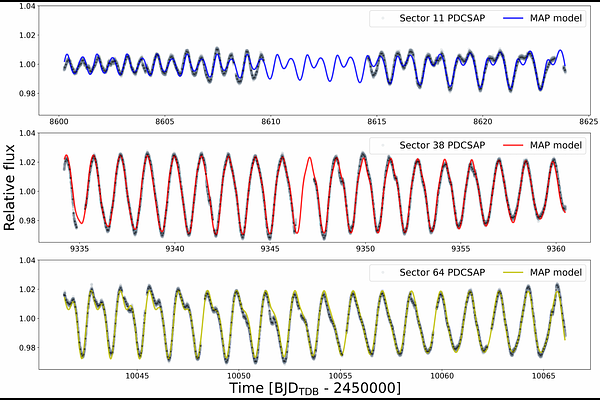
AbstractHIP 67522 is a one of the youngest multi-planetary systems discovered to date. The 17 Myr-old, Sun-like star is part of the Scorpius-Centarus OB association and is known to host two Saturn-sized planets in near 2:1 mean motion resonance. We analysed photometric transits observed with the CHaracterising ExOPlanet Satellite (CHEOPS), the Transiting Exoplanets Survey Satellite (TESS) and multiple ground-based facilities to search for transit timing variations induced by planet-planet gravitational interactions, as well as transit depth variations, linked with the changing coverage of active regions on the stellar surface. We do not detect any transit timing variations for HIP 67522 b exceeding two minutes, contrary to previous results from the James Webb Space Telescope. In addition, we found that the observed transit depth of planet b changes strongly over time, with a >30\% variation in amplitude. The high sensitivity and blue bandpass of the CHEOPS satellite also enabled us to identify multiple starspot crossings and measure their properties, including spot temperatures and sizes. We also measured the shear of the host star's differential rotation by modelling the out-of-transit photometric variability and concluded that HIP 67522 exhibits a supersolar differential rotation. Based on internal structure models and planet formation simulations, we find that HIP 67522 b likely have more than 20\% of their mass made of gaseous envelopes at their current age. Evolutionary simulations further indicate that both planets in the system will experience significant photoevaporation, evolving into either Earth size planets with completely stripped atmospheres or sub-Neptune-sized planets.