A break in planet occurrence near the pebble isolation mass should be observable by the Roman microlensing survey

A break in planet occurrence near the pebble isolation mass should be observable by the Roman microlensing survey
Claudia Danti, Michiel Lambrechts, Hannah Diamond-Lowe
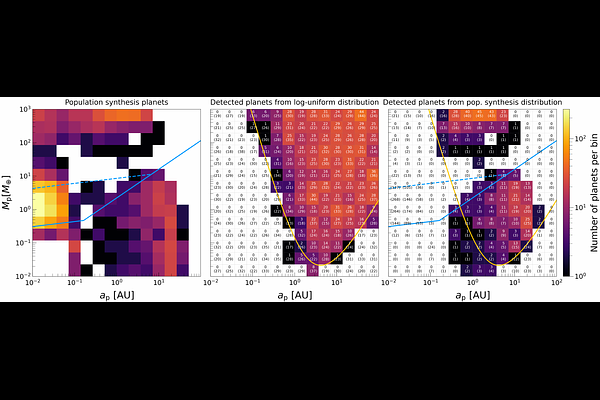
AbstractMicrolensing detections are uniquely well-suited to probing the population of planets outside the water iceline, down to planetary masses comparable to the Earth. Here, we perform 1D pebble-accretion population synthesis simulations to explore a sample of iceline planets around stars with masses and metallicities similar to the target population of the Galactic Bulge Time-domain microlensing survey of the Nancy Grace Roman Space Telescope. We find that the planet distribution in the microlensing sensitivity space deviates from a log-uniform distribution in mass and orbital radius. When planetary core growth comes to a halt as planets reach the pebble isolation mass, $M_{\mathrm{iso}}$, the combined effects of planetary migration and runaway gas accretion create an occurrence break. Our simulations highlight that, between 1 and 50 AU, the fraction of stars hosting isolation-mass planets (1 to 5 $M_{\mathrm{iso}}$) is lower by a factor 20 compared to less massive planets (0.2 to 1 $M_{\mathrm{iso}}$). If this break in planetary occurrence rates around the pebble isolation mass is detected in future lensing surveys, it would further validate the core accretion paradigm for giant planet formation.