Where Did the Angular Momentum Go? WASP-12 b May Have Circularized on a Retrograde Orbit

Where Did the Angular Momentum Go? WASP-12 b May Have Circularized on a Retrograde Orbit
Elina Y. Zhang, Fei Dai, Yaguang Li, Jennifer van Saders, Morgan Saidel, Heather A. Knutson, Daniel Huber, Jingyi Zhang, Andrew W. Howard, Samuel P. Halverson, Howard Isaacson, Ryan A. Rubenzahl, Benjamin J. Fulton, Jack Lubin, Luke B. Handley, Steven Giacalone, Erik A. Petigura, Jingwen Zhang, Rafael Luque, Judah Van Zandt, Joshua N. Winn, Simon H. Albrecht, Samuel W. Yee, Xian-Yu Wang, Songhu Wang, Steve R. Gibson, Kodi Rider, Arpita Roy, Ashley Baker, Jerry Edelstein, Christopher L. Smith, Josh Walawender
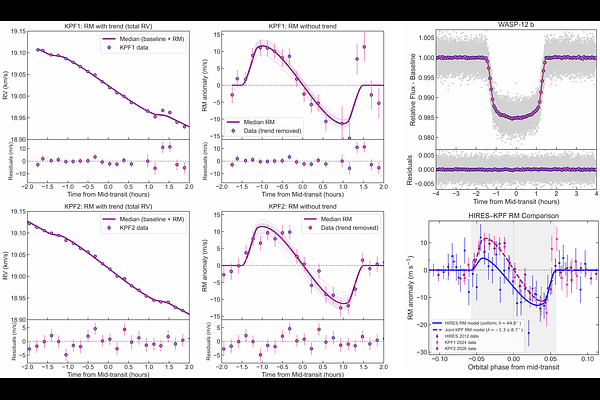
AbstractWASP-12 b is the only exoplanet with confirmed orbital decay. Angular momentum transferred from its decaying orbit should have realigned the star's thin convective layer, yet an earlier Rossiter--McLaughlin (RM) measurement suggested a $\sim$60$^\circ$ spin--orbit misalignment. We present two new Keck Planet Finder RM measurements. We measure a sky-projected obliquity of $λ=-1.3\pm8.7^\circ$; and the star's projected rotation velocity is $v\sin i_\star=1.3\pm0.1~\mathrm{km\,s^{-1}}$, an order of magnitude lower than expected for a star of its mass and age. With WASP-12's low chromospheric activity, $\log R^\prime_{\rm HK}=-5.5$, our analysis favors an aligned system in which $v\sin i_\star$ reflects slow surface rotation with $P_{\rm rot}\sim60$ days, rather than a projection effect. Our evolution models favor a late-main-sequence star rather than a subgiant, with a central convective core found in 99\% of posterior samples. This internal structure suppresses the central-focusing and nonlinear wave-breaking mechanisms for inward-propagating gravity waves. We propose that WASP-12 b was initially placed on a retrograde orbit after high-eccentricity migration, when its host rotated at $v\sin i_\star\approx14$~km~s$^{-1}$ (or $P_{\rm rot}\sim$6 days). Tidal decay transferred orbital angular momentum to the convective envelope, aligning the surface. The retrograde interior acts as an angular-momentum reservoir, while interior--envelope coupling slows the surface rotation. A semi-empirical relation gives an envelope--interior angular-momentum exchange timescale of $\sim4$~Myr, similar to the observed orbital-decay timescale of $\sim3.25$~Myr. The angular-momentum budget also permits this initially retrograde evolution. In contrast, an initially prograde planet would have spun up the surface rotation to a rate substantially higher than observed.