Extreme Ultraviolet Microflashes at Plume Bases: A Candidate for Powering the Corona and Solar Wind?

Extreme Ultraviolet Microflashes at Plume Bases: A Candidate for Powering the Corona and Solar Wind?
Navdeep K. Panesar, Sanjiv K. Tiwari, Meng Jin, Ayla Weitz, Ronald L. Moore, V. Aparna, Alphonse Sterling
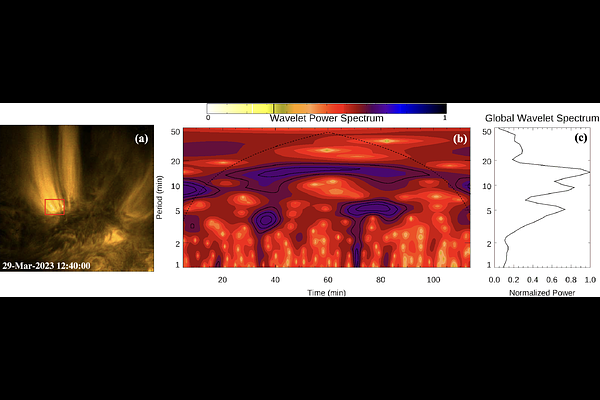
AbstractSolar plumes - outflows of bright coronal plasma - are a major component of the open-magnetic-field corona and solar wind, but their driving mechanism remains uncertain. Here we report on network microflashes, fine-scale bright bursts captured by Solar Orbiters Extreme Ultraviolet Imager in 174A images encompassing magnetic network at the base of plumes. Because they sit in evidently unipolar magnetic flux, they are evidently a new, previously unidentified, kind of network event. Approximately 20 microflashes are ongoing within a plume base, with a new microflash starting every second. The energy for an average microflash is 1024 erg, in the range of nanoflares. A 3D data-driven global MHD model yields open magnetic field with fast solar wind for the investigated plumes. From our findings, we suggest that network microflashes result from fine-scale bursts of reconnection of crossed legs of unipolar magnetic field, that the bursts are often triggered by 5-minute p-mode oscillations, and that the bursts are candidates for powering the open-field corona and solar wind. That is, unipolar microflashes such as ours are plausibly from unipolar-network-field reconnection bursts that sustain the heliosphere.