Investigation of the gravitational dust collapse of the LQG-inspired effective asymmetric bounce model

Investigation of the gravitational dust collapse of the LQG-inspired effective asymmetric bounce model
Kristina Giesel, Hongguang Liu, Eric Rullit
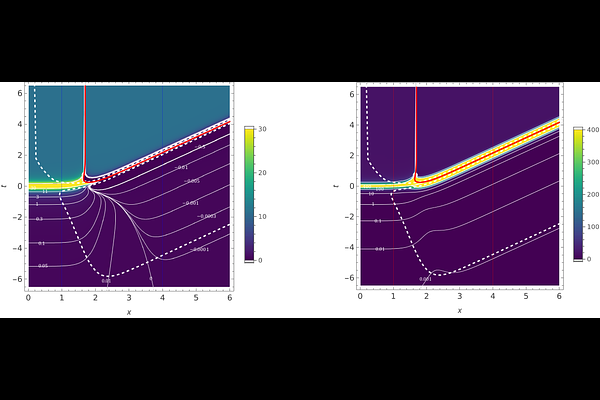
AbstractWe investigate gravitational dust collapse within an effective loop quantum gravity (LQG)-inspired model exhibiting an asymmetric bounce in the marginally bound case. This work extends previous studies, which have predominantly focused on models with either symmetric bounces or asymmetric bounces restricted to homogeneous dust configurations. Our analysis emphasises the phenomenological implications of the model through a combination of analytical and numerical investigations, with particular attention to singularity resolution and the formation of trapped surfaces. As in symmetric bounce models, the central curvature singularity inside the collapsing dust cloud is resolved. However, in contrast to the symmetric case, we find that a singularity emerges in the polymerised vacuum region during the bounce phase. This singularity can be identified as a shell-crossing singularity and exhibits the expected power-law behaviour of curvature scalars. Furthermore, likewise to the symmetric bounce models, we find a critical mass threshold governing the formation of inner and outer horizons in the pre-bounce phase. No analogous critical mass restriction arises for the formation of the inner horizon in the post-bounce phase, highlighting a qualitative difference between the pre- and post-bounce dynamics.