Quantum light source with lithium tantalate for scalable photonic quantum circuits

Quantum light source with lithium tantalate for scalable photonic quantum circuits
Yun-Ru Fan, Bo-Wen Chen, Dan Xu, Cheng-Li Wang, Hong Zeng, Jia-Qi Wang, Xu-Qiang Wang, Jia-Chen Cai, Hai-Zhi Song, Hao Li, Li-Xing You, Yan-Yu Wei, Kai Guo, Xin Ou, Guang-Can Guo, Qiang Zhou
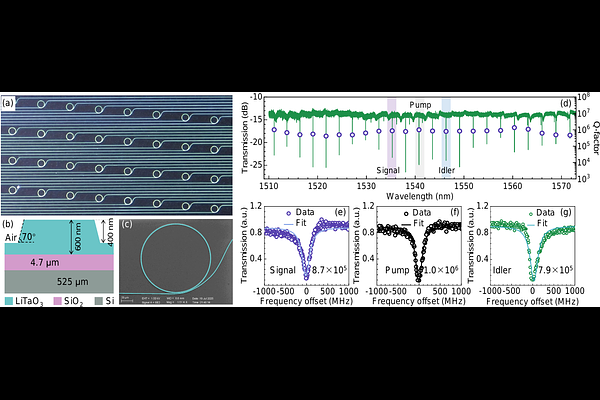
AbstractThin-film lithium tantalate (TFLT) has emerged as a promising integrated photonic platform owing to its low photorefractive noise, high optical damage threshold, and reduced birefringence, attracting increasing interest for scalable photonic technologies. Here, to the best of our knowledge, we demonstrate the first quantum light source with TFLT via spontaneous four-wave mixing, bridging the gap between the rapidly advancing classical TFLT ecosystem and integrated quantum photonics. The fabricated microring exhibits a free spectral range of 350~GHz and an optical quality factor of $10^6$, enabling efficient cavity-enhanced nonlinear interactions. Correlated photon pairs are generated across the telecom band from 1510 to 1570~nm, with a photon pair generation rate of 24 $\mathrm{MHz/mW^{2}}$ at a wavelength of 1535.04 nm. The source delivers strongly antibunched heralded single photons with $g^{(2)}_{H}(0)=0.071\pm0.004$ at a heralding rate of 170 kHz, while the unheralded statistics yield $g^{(2)}(0)=1.93 \pm 0.05$, indicating near-single-temporal-mode emission. Energy-time entanglement is further confirmed by a raw two-photon interference visibility of $92.55\pm0.94\%$, well above the Bell-inequality violation threshold. These results establish TFLT as a manufacturing-compatible platform for scalable photonic quantum circuits, paving the way for the monolithic co-integration of classical and quantum photonic functionalities.