Interstellar Medium-Driven Orbital Transport -- I. Radial Heating and Migration

Interstellar Medium-Driven Orbital Transport -- I. Radial Heating and Migration
Shaunak Modak, Chris Hamilton, Eve C. Ostriker, Scott Tremaine
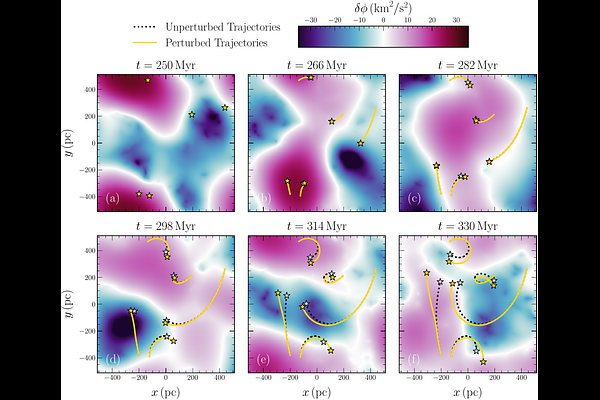
AbstractInterstellar medium (ISM) structures gravitationally perturb stellar orbits in galactic disks, driving orbital heating and migration. However, studies of these transport processes tend to model the ISM very crudely, e.g., as a collection of compact, spherical ``clouds'' moving in the disk plane. Here, we revisit this problem with more realistic models of ISM density fluctuations drawn from the TIGRESS-NCR magnetohydrodynamic simulations, which follow the physics governing the ISM in Milky-Way-like conditions at high resolution. By integrating test-particle trajectories through time-dependent TIGRESS-NCR structures, we uncover transport behavior that contrasts sharply with conventional theoretical expectations. Notably, radial heating scales as $σ_R \propto t^{1/2}$ for initially cold orbits at early times, and $σ_R \propto t^{1/5}$ for warmer orbits at late times, contrary to the classic $σ_R \propto t^{1/3}$ prediction. The ISM drives substantial radial migration, accounting for $\gtrsim 30\%$ of that observed in the solar neighborhood (even without stellar spiral structure), and leads to a very low heating-to-migration ratio of $\mathrm{rms}\,δJ_R\,/\,\mathrm{rms}\,δJ_\varphi \approx 0.055$, where $J_R$ and $J_\varphi$ are the radial and azimuthal actions respectively. Vertical motion suppresses the amplitude of radial transport, but does not change the basic scalings. All our simulation results can be explained using quasilinear diffusion theory, accounting for the fact that the dominant ISM fluctuations have wavelengths of $λ_* \sim 600\,$pc and correlation timescales of $τ_* \sim 70\,$Myr. We provide simple fitting formulae for the corresponding diffusion coefficients. In Paper II, we study the ISM's role in vertical disk heating.