A fast method to derive relative small-scale magnetic field variations from high resolution spectroscopy

A fast method to derive relative small-scale magnetic field variations from high resolution spectroscopy
Paul I. Cristofari, Steven H. Saar, Aline A. Vidotto, Stefano Bellotti
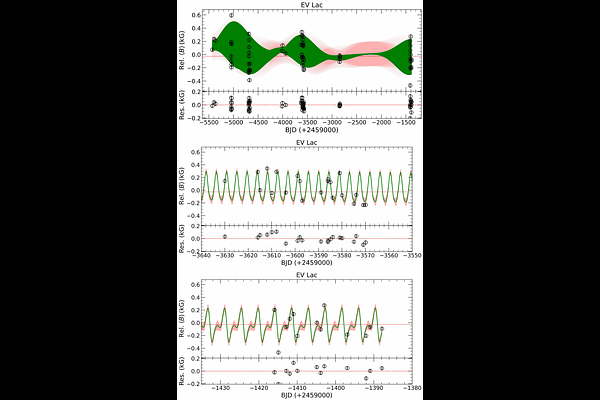
AbstractObservational constraints on stellar magnetic fields are essential to both stellar and planetary physics. Recent studies revealed the diversity and evolution of large-scale magnetic fields in low-mass stars. These large-scale fields only account for a small fraction of the observed unsigned magnetic flux. Most of the surface magnetic flux if accounted for by small (spatial) scale magnetic fields, which exhibit clear temporal evolution of time scales of years. We aim at developing new techniques to extract small-scale magnetic field estimates from time series of observed spectra. Our ultimate goal is to study the temporal evolution of small-scale magnetic fields which will provide insight into the magnetic properties of low-mass stars and their magnetic cycles. We implement a process to capture relative pixel variations caused by changes in magnetic field strengths, relying on synthetic spectra computed with ZeeTurbo. This approach provides extremely fast and reliable estimates of relative magnetic field strength variations from series of high-resolution spectra, mitigating the impact of systematics between models and observations. We assess the performance of the proposed method through its application to simulated data and publicly available spectra. In addition, we implement a model-driven process to derive relative temperature variations and explore the influence magnetic fields have on these measurements. Our results are in excellent agreement with previous magnetic field estimates. The method provides robust constraints and proves to be relatively insensitive to small changes in the assumed atmospheric parameters and broadening. We find that magnetic field variations have the potential of introducing biases in relative temperature estimates, in particular for domains containing a large number of magnetically-sensitive transitions.