Rotating Fermion-Boson Stars in $R$-squared Gravity

Rotating Fermion-Boson Stars in $R$-squared Gravity
Saeed Fakhry, Jorge Castelo Mourelle, Nicolas Sanchis-Gual, Daniela Doneva, Stoytcho Yazadjiev, José A. Font
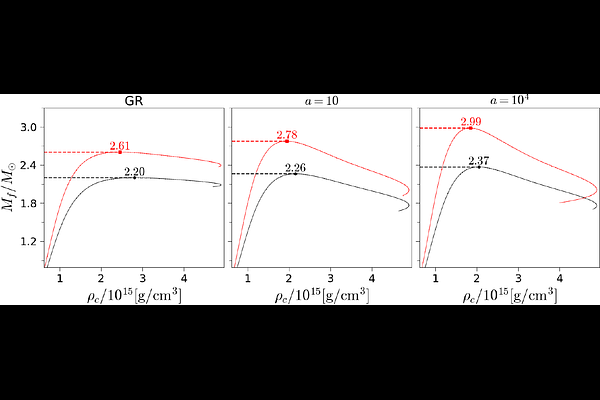
AbstractFermion-boson stars are compact equilibrium configurations composed of ordinary fermionic matter and a bosonic dark component interacting only through gravity. Such systems provide a natural framework for exploring deviations from standard neutron-star models, including the possible accumulation of dark matter inside neutron stars, and may be relevant for compact objects near the low-mass black-hole gap. We construct static and uniformly rotating fermion-boson stars within the framework of $R$-squared $f(R)$ gravity, characterized by the functional form $f(R)=R+aR^{2}$, where $a$ is a positive parameter governing the effective mass scale from the scalar degree of freedom. The fermionic sector is modeled as a perfect fluid described by a tabulated equation of state at zero temperature, while the bosonic component is represented by a self-interacting complex bosonic field. Our results show that the scalar degree of freedom modifies the spatial distribution of both the bosonic field and the fermionic pressure, enlarges the domain of admissible equilibrium solutions, and increases the maximum supported masses relative to general relativity. Our models remain compatible with current astrophysical and gravitational-wave constraints, suggesting that fermion-boson stars in $R$-squared gravity offer a promising framework to investigate the combined effects of dark bosonic matter, rotation, and strong-field modifications of gravity in compact objects.