Fine-scale downflows above flare ribbons captured by Solar Orbiter/EUI

Fine-scale downflows above flare ribbons captured by Solar Orbiter/EUI
Zheng Sun, Alexander G. M. Pietrow, Malcolm K. Druett, Hui Tian, Julián D. Alvarado-Gómez, Song Tan, Alexander Warmuth, Jiasheng Wang, Yuhang Gao, Zhenyong Hou, Alexandros Stork
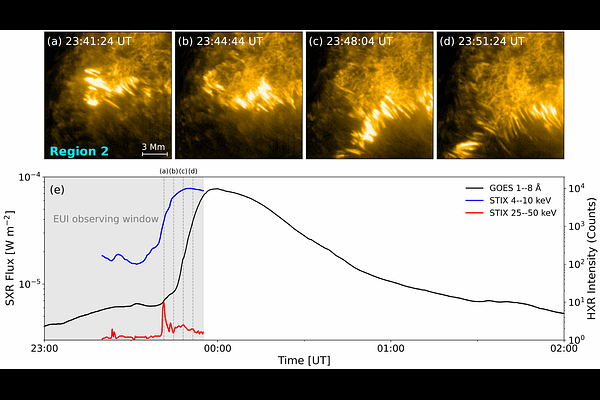
AbstractIn solar flares, flare ribbons map chromospheric footpoints where flare energy deposition occurs. These locations are associated with field aligned energy transport from the corona that results from energy liberated during magnetic reconnection. Recent chromospheric observations in the H$α$ and H$β$ bands have revealed fine-scale downflow structures above flare ribbons, referred to as riblets. In this study, we identify similar downflow structures in the extreme-ultraviolet (EUV) wavelength using high-resolution observations from Solar Orbiter/EUI. These fine-scale downflows appear as downward-propagating, bright, and thread-like structures. They exhibit typical velocities of $\sim100~\mathrm{km\ s^{-1}}$, lifetimes of $\sim15$~s, and lengths of $\sim1.6$~Mm. Based on their morphological and dynamical properties, we interpret these observed downflows as the EUV counterparts of the riblets that have previously been reported from chromospheric observations. This study presents EUV imaging of $\sim 10^6$~K downflows above flare ribbons. We interpret these downflows as a result of (1) the energisation and subsequent compression of pre-existing chromospheric fibrils due to particle beams or (2) adiabatic or shock-driven compression induced by the downward-propagating plasma from the corona. These fine-scale EUV riblets provide a new diagnostic tool for probing the dynamics of magnetic reconnection as well as energy transport and deposition during solar flares.