The Silk Nebula Revisited: A Comment on Wu et al. (2026) and New Constraints from Archival Survey Spectroscopy

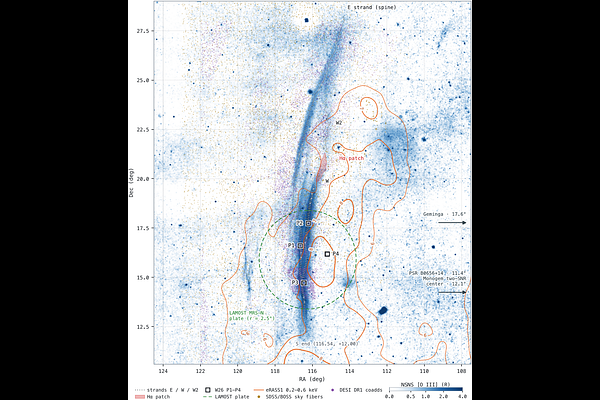
The Silk Nebula Revisited: A Comment on Wu et al. (2026) and New Constraints from Archival Survey Spectroscopy
Zhuo-Xiao Wang
AbstractWu et al. (2026) used one LAMOST MRS-N plate to suggest that the Silk Nebula, a $17^\circ$-long \Oiii~$λ$5007 filament in Gemini, is possibly associated with a supernova remnant at a fiducial distance of $\sim$160\,pc. We test this against their published values and independent archival data. The \Ni\ airglow in their blue-arm spectrum lies at air, topocentric rest wavelengths, so their \Oiii\ velocities omit the heliocentric correction and are $10.1\pm1.0$\,\kms\ too high. Corrected and combined with DESI DR1 and SDSS spectra, \Oiii\ lies at \vhel\ $=+13.3\pm1.0$\,\kms, the velocity of \Nii\ and of the local warm ionized medium (WIM). Their \Ha\ velocities are 4.5--6.7\,\kms\ redder than \Nii. Their tabulated distances are in kpc, not units of 100\,pc, and kinematic distances carry no information in this direction. Their surface brightness exceeds independent measurements (1.4--2.5 rayleighs) by factors of 4.6--8.6. Their red-line shock criteria are met equally in their nebula-free background region and describe the WIM; their other remnant diagnostics do not constrain the filament. DESI and SDSS spectra show that the filament is Balmer-dark (\Oiii/\Hb\ $>11$) and \Oii-strong, with \ion{He}{2}/\Oiii\ $<0.026$; GALEX shows a coincident ultraviolet ridge, with no \Ha, \ion{H}{1}, dust or X-ray counterpart. These properties, and the lack of an ionizing source, exclude photoionization equilibrium and complete radiative shocks and match a column-truncated radiative shock of $\sim$80--120\,\kms\ seen edge-on, plausibly on the limb of the Monogem Ring at $\sim$250--320\,pc. Far-ultraviolet and deep optical spectroscopy, a two-epoch proper motion and high-ion absorption toward bracketing white dwarfs would be decisive.