Characterizing Orbital Parameters of Hot Subdwarf Binaries with Multiple Spectroscopic Surveys

Characterizing Orbital Parameters of Hot Subdwarf Binaries with Multiple Spectroscopic Surveys
XInlin Zhao, Song Wang, Zhenxin Lei, Yangyang Dong, Buhui Lv, Chuanjie Zheng, Xiaohong Yang, Jifeng Liu
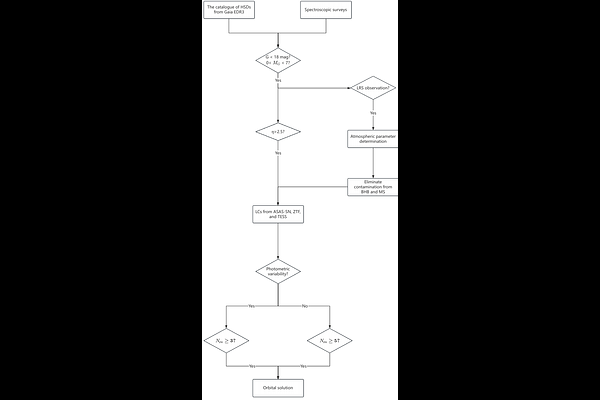
AbstractHot subdwarfs (HSDs) provide critical insights into the physical mechanisms governing binary evolution. In this work, we conduct a systematic analysis of 157 HSDs, selected from Gaia EDR3 and characterized using multi-survey spectroscopic data. Atmospheric parameters of these HSDs are derived via a convolutional neural network (CNN) method and template-matching method. Based on the atmospheric parameters from CNN method, these HSDs exhibit a median mass of $0.45^{+0.19}_{-0.17} M_{\odot}$ and radius of $0.18^{+0.04}_{-0.05} R_{\odot}$, consistent with earlier work. Orbital parameters of 23 systems are determined through the fitting of radial velocity data and light curves, with 11 of them being new solutions. We find that reflection-dominated binaries typically have periods longer than 0.1 d and host low-mass main-sequence companions ($\sim$ 0.2 $M_{\odot}$) with rotation-inflated radii. In contrast, binaries including an HSD and a white dwarf show very short periods ($P < 0.2$ d), with the closest systems hosting more massive white dwarfs. Most of these systems share a similar mass--period distribution with that of post-common-envelope binaries, supporting a common-envelope origin.