Uncovering subdominant multipole asymmetries in binary black-hole mergers

Uncovering subdominant multipole asymmetries in binary black-hole mergers
Jannik Mielke, Angela Borchers, Frank Ohme
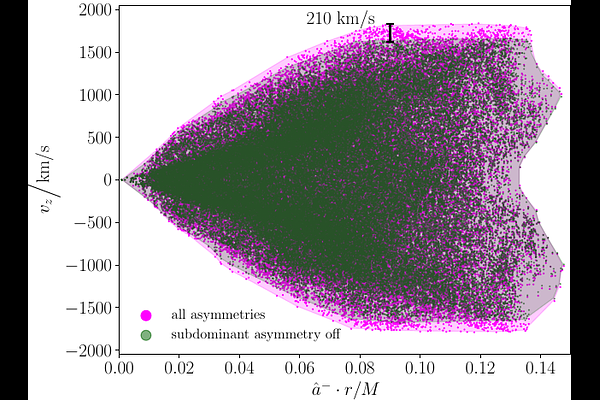
AbstractIn dynamically formed binaries, the spins of the black holes tend to be misaligned with the system's orbital angular momentum. This causes the spins to precess and leads to an asymmetric emission of gravitational waves. The resulting gravitational-wave multipole asymmetries directly source the recoil of the remnant black hole and are the critical element in fully describing precession. Recoil and precession are of significant astrophysical importance, but multipole asymmetries contribute only minimally to the overall signal strength. Consequently, most current gravitational-wave models either do not incorporate asymmetries at all, or only consider the dominant ones. Here we highlight the importance of subdominant multipole asymmetries for an accurate recoil velocity calculation and discuss their detectability with third generation detectors. Neglecting subdominant asymmetries leads to velocity differences of up to 210 km/s and can, in particular, introduce systematic biases in the inference of masses and the spin geometry. We further discuss universal characteristics of subdominant multipole asymmetries in order to prepare the ground for potential future asymmetry models. In the inspiral regime, the average antisymmetric frequencies can be described by a multiple of the orbital frequency. During ringdown, however, they become equal to their corresponding symmetric frequencies.