PAHSPECS: Spatially Resolved PAH Spectroscopy at cosmic noon with JWST MIRI MRS

PAHSPECS: Spatially Resolved PAH Spectroscopy at cosmic noon with JWST MIRI MRS
Fergus R. Donnan, Karin Sandstrom, Irene Shivaei, Leindert A. Boogaard, Tanio Díaz-Santos, Cristina M. Lofaro, Román Fernández Aranda, Manuel Aravena, Roberto Decarli, Hanae Inami, Pablo G. Pérez-González, Gergö Popping, Paul P. van der Werf
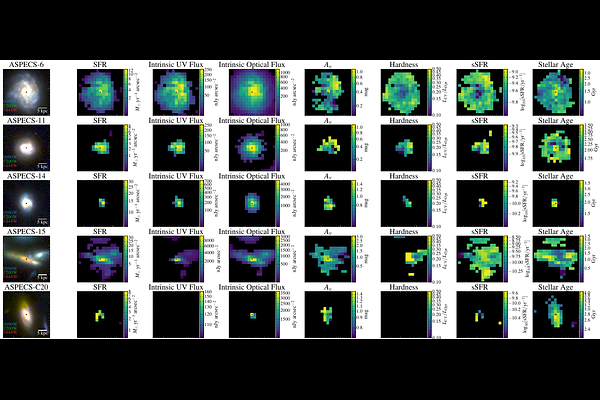
AbstractWe present spatially resolved spectroscopy with JWST/MIRI MRS of a representative sample of normal star-forming galaxies at $z\sim1.1$ as part of the PAHSPECS program. To extract emission from Polycyclic Aromatic Hydrocarbon (PAH) features, we forward model the data cubes with non-parametric spatial distributions, accounting for convolution with the PSF. With this method we are able to recover accurate spatial profiles of the 3.3 $μ$m, 6.2 $μ$m, 7.7 $μ$m, 11.3 $μ$m PAHs and [ArII] (6.98 $μ$m) emission and produce PAH ratio maps at cosmic noon. From the PAH ratio maps we find that PAHs become larger and more neutral with increasing galactocentric radius, which is the opposite of trends in local galaxies, indicating radial ISM gradients in normal star-forming galaxies are different at cosmic noon. Through spatially resolved SED fitting of HST and JWST photometry we measure the UV radiation field hardness through the intrinsic ratio of UV to optical flux and find the 3.3/11.3 PAH ratio to decrease with increasing hardness and the 11.3/7.7 to increase. This may suggest photo-destruction of small/ionized PAHs is driving the observed PAH ratio trends and may explain the overall lower 3.3/11.3 PAH at cosmic noon compared to the local universe. This work demonstrates that PAH properties hold crucial information on the resolved ISM physics of galaxies at cosmic noon.