Low-Latency Alerts of Massive Black Hole Binaries in LISA

Low-Latency Alerts of Massive Black Hole Binaries in LISA
Rahul Srinivasan, Lorenzo Copparoni, Chantal Pitte, Enrico Barausse, Roberto Trotta
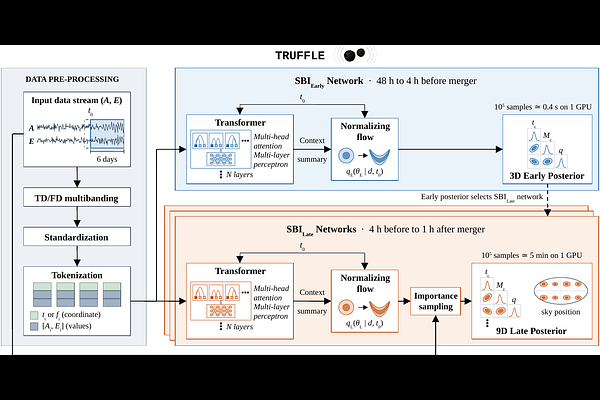
AbstractThe Laser Interferometer Space Antenna (LISA) will observe massive black hole binaries (MBHBs) for days to months before merger, offering opportunities for advance electromagnetic follow-up. To enable such observations, inference methods must provide rapid, continuously updated, and statistically calibrated posterior estimates, while remaining robust to overlapping sources. We present TRUFFLE (Time-evolving Rapid Updates For Follow-up of LISA Events), a simulation-based inference method for MBHBs in LISA data designed to meet these requirements. Our approach uses two networks, selected according to the time to coalescence relative to the end of the analysis window, $Δt_c$. An early-warning network, operating at $Δt_c \in [4~\mathrm{h}, 2~\mathrm{d}]$, estimates the chirp mass, mass ratio, and coalescence time to support electromagnetic follow-up scheduling. A near-merger network, operating at $Δt_c \in [-1~\mathrm{h}, +4~\mathrm{h}]$, infers nine parameters, including the sky position needed for telescope pointing. Both networks process the most recent six days of data using multiband time- and frequency-domain representations, which are summarized by a transformer to condition a normalizing flow. The networks are trained on the full orbit-driven LISA response and amortized over a 30-day range of observation epochs. The near-merger posterior can be corrected through likelihood-based importance sampling, with neural inference taking seconds and likelihood reweighting approximately five minutes on a single GPU. We obtain unbiased posteriors in the presence of overlapping sources, including plunging extreme-mass-ratio inspirals, resolvable Galactic binaries, and additional MBHBs merging up to two hours before the primary merger.