Mechanism for reduction of the afterpulsing rate of PMTs

Mechanism for reduction of the afterpulsing rate of PMTs
Kai Morita, Mitsunari Takahashi, Habib Ahammad Mondal, Hidetoshi Kubo, Hideyuki Ohoka, Seiya Nozaki, Shunsuke Sakurai, Takayuki Saito, Tokonatsu Yamamoto, Yusuke Inome
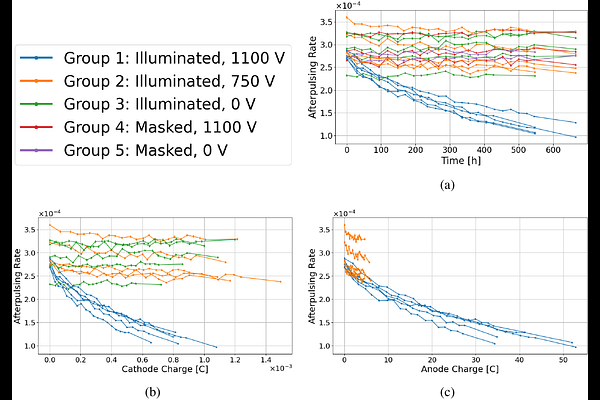
AbstractPhotomultiplier tubes (PMTs) are used in Imaging Atmospheric Cherenkov Telescopes (IACTs) to detect Cherenkov light produced by air showers induced by gamma rays in the atmosphere. The afterpulsing rate of the PMTs for the Large-Sized Telescopes (LSTs) of the Cherenkov Telescope Array Observatory (CTAO) was found to increase if they were kept unused in storage. In contrast, PMTs that had been operated in the first LST showed a slight decrease in the rate. This decrease could be explained by a reduction of residual gas caused by ion feedback, although the detailed mechanism remained unclear. In this study, to investigate factors responsible for the evolution in the afterpulsing rate, we operated several PMTs under different high voltage and light illumination conditions. We monitored their rate daily for three weeks to compare their evolution under different conditions. We found that the reduction of afterpulses require both illumination and high-voltage operation. Notably, the reduction strongly depends on the applied high voltage and is closely correlated with the integrated anode current. Therefore, we conclude that the reduction of residual gas is mainly caused by ionization occurring at later dynodes of the PMTs, and the ions are trapped by the dynodes. We also discuss a possible explanation of the reduction of afterpulsing rate by later dynodes.