\texttt{py5vec}: a modular Python package for the 5-vector method to search for continuous gravitational waves

\texttt{py5vec}: a modular Python package for the 5-vector method to search for continuous gravitational waves
Luca D'Onofrio, Federico Muciaccia, Lorenzo Mirasola, Matthew Pitkin, Cristiano Palomba, Paola Leaci, Francesco Safai Tehrani, Francesco Amicucci, Lorenzo Silvestri, Lorenzo Pierini
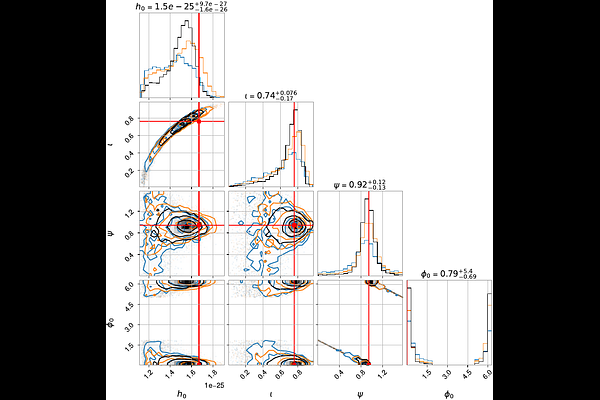
AbstractWe present \texttt{py5vec}, a Python package for implementing and extending the 5-vector method, used to search for continuous gravitational wave (CW) signals. We also provide a comprehensive theoretical review of the 5-vector method and extend the relative likelihood formalism by marginalizing over the noise variance, resulting in a more robust Student's t-likelihood, and over the initial phase to account for pulsar glitches. \texttt{py5vec} provides a modular architecture that separates data representation, signal demodulation, and statistical inference into independent abstract stages. It supports multiple input data formats and interoperates with existing Python software, providing a bridge between different approaches. For example, using a \texttt{bilby}-based interface, \texttt{py5vec} implements Bayesian parameter estimation within the 5-vector formalism for the first time. The modular design also allows for making exact multi-level and direct comparisons between other software, such as \texttt{cwinpy} and \texttt{SNAG} in MATLAB. In \texttt{py5vec}, we implement a multidetector targeted search for known pulsars, validated using LIGO data from the O4a run and hardware injections, demonstrating consistent reconstruction of signal parameters. This package therefore provides a flexible platform for current targeted searches and for future extensions to other CW search strategies.