The ESPRESSO Redshift Drift Experiment III -- The Third Epoch of QSO J052915.80-435152.0

The ESPRESSO Redshift Drift Experiment III -- The Third Epoch of QSO J052915.80-435152.0
Andrea Trost, Catarina M. J. Marques, S. Cristiani, Guido Cupani, Simona Di Stefano, Valentina D'Odorico, Francesco Guarneri, Carlos J. A. P. Martins, Dinko Milaković, Luca Pasquini, Ricardo Génova Santos, Paolo Molaro, Michael T. Murphy, Nelson J. Nunes, Tobias M. Schmidt, Yann Alibert, Konstantina Boutsia, Giorgio Calderone, J. I. González Hernández, Andrea Grazian, Gaspare Lo Curto, Enric Palle, Francesco Pepe, Matteo Porru, Nuno C. Santos, Alessandro Sozzetti, Alejandro Suárez Mascareño, Maria R. Zapatero Osorio
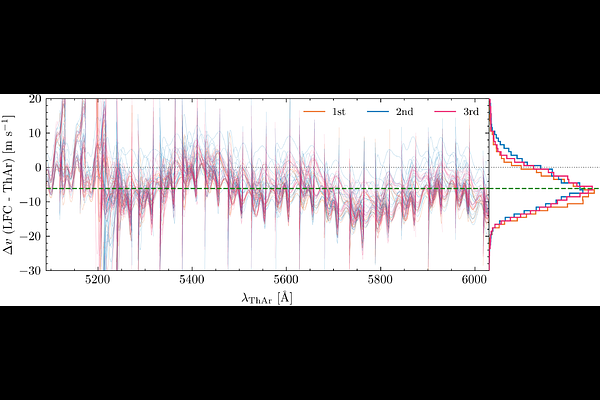
AbstractThe Sandage-Loeb test probes cosmic expansion directly by measuring the redshift drift in quasar absorption features in a model-independent way. In this series of papers, we have launched an observational campaign to assess whether current instrumentation is capable of measuring this effect and what systematic effects might interfere with a detection. We report the observations and analysis of the third epoch of ESPRESSO observations of the bright quasar J052915.80-435152.0 (SB2, z=3.962), extending the temporal baseline to $\sim2$ years, and providing the tightest constraints on the redshift drift in the series so far. We acquired 9.5 hours of ESPRESSO observations, complementing the 12 hours presented in the first paper of the series, with one year of separation from the second epoch. The complete dataset was analysed and compared to spline-based Lyman-$α$ forest models calibrated on simulations, to measure the presence of any velocity drift among the spectra. The measurement was carried out with two independent methods. Both approaches give a consistent null result, $\dot{v} = -3.5 \pm 3.6 ~{\rm m s^{-1} yr^{-1}}$ (or $\dot{z} = (-5.3\pm5.6)\times 10^{-8}~{\rm yr^{-1}}$ in redshift space), in agreement with $Λ$CDM expectations, systematic effects remain subdominant at the present level of noise. By extrapolating the results from the observed sightline to the complete QUBRICS Golden Sample, we show that ESPRESSO alone could detect the signal on century timescales, while a joint ESPRESSO+ANDES programme would reach first detection before 2080. A future analysis of the other quasars of the QUBRICS Golden Sample is required to improve this estimate. We show that the program would greatly benefit from a complementary effort with radio facilities targeting low-z HI 21 cm absorption lines. Such synergy could reduce the experiments' timeline by up to $\sim10$ years.