On the contradictory case of the binary system HD 81809 hosting two pulsating solar-like stars observed by TESS

On the contradictory case of the binary system HD 81809 hosting two pulsating solar-like stars observed by TESS
Maria Pia Di Mauro, Camilla Pezzotti, Nuno Moedas, Giovanni Catanzaro, Pierre F. L. Maxted, Enrico Corsaro, Raffaele Reda, Richard Scuflaire, Alfio Bonanno, Luca Giovannelli, Paul G. Beck
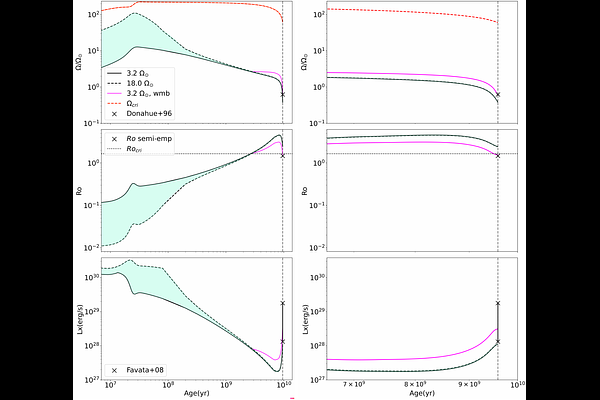
AbstractWe present a new comprehensive study of HD81809, a nearby binary system of two solar-like stars showing high-amplitude X-ray emission and a well-defined 8-year solar-like magnetic cycle. By analyzing high-resolution spectroscopy, alongside DR3 Gaia astrometry, and bolometric fluxes, we derive updated fundamental parameters for both components. In particular, we uncover a significant chemical difference: the primary is metal-poor ([Fe/H]$ \simeq - 0.57$), while the secondary shows solar-like metallicity ([Fe/H]$=0.00$). This suggests that the system originated in a mildly metal-poor environment, consistent with the Galactic thick disk population, and that the secondary's surface composition has been altered by a recent accretion event. Using multi-sector TESS photometry, we detected solar-like oscillations in both components, deriving global asteroseismic parameters $Δν= 43.32 \pm 3.91 μ$Hz, $ν_{\rm max} = 708.74^{+3.23}_{-3.74} μ$Hz for HD81809 A, and $Δν= 97.75 \pm 4.49~μ$Hz, $ν_{\rm max} = 2098.07^{+3.07}_{-2.83} μ$Hz for HD81809 B. By combining all the observational constraints with stellar evolutionary models computed using CLES and MESA codes, we reconstructed the evolutionary scenario of the system. Our results indicate that HD 81809 is an old system with an age of $\sim 10 \mathrm{Gyr}$, composed of a subgiant primary with mass $\sim 0.87M_{\odot}$ and radius $\sim1.96R_{\odot}$ - likely responsible for the reactivated dynamo cycle - and a main sequence secondary with mass $ M=0.85M_{\odot}$ and radius $R=1.10R_{\odot}$. This system represents a benchmark for studying stellar evolution, magnetic activity, and the physics of old, metal-poor stars in the Galactic thick disk.