$\texttt{Exoformer}$: Accelerating Bayesian atmospheric retrievals with transformer neural networks

$\texttt{Exoformer}$: Accelerating Bayesian atmospheric retrievals with transformer neural networks
L. Pagliaro, T. Zingales, G. Piotto, I. Giovannini, G. Mantovan
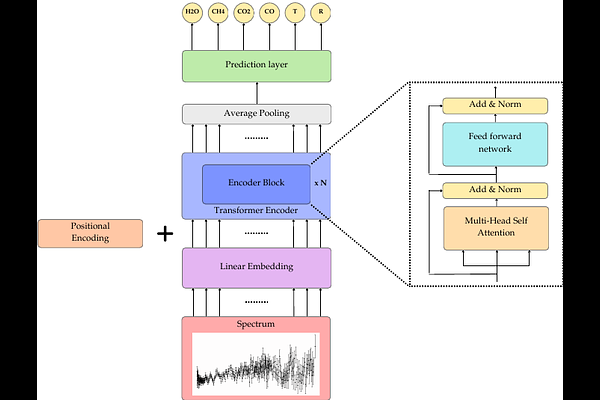
AbstractComputationally expensive and time-consuming Bayesian atmospheric retrievals pose a significant bottleneck for the rapid analysis of high-quality exoplanetary spectra from present and next generation space telescopes, such as JWST and Ariel. As these missions demand more complex atmospheric models to fully characterize the spectral features they uncover, they will benefit from data-driven analysis techniques such as machine and deep learning. We introduce and detail a novel approach that uses a transformer-based neural network ($\texttt{Exoformer}$) to rapidly generate informative prior distributions for atmospheric transmission spectra of hot Jupiters. We demonstrate the effectiveness of $\texttt{Exoformer}$ using both simulated observations and real JWST data of WASP-39b and WASP-17b within the TauREx retrieval framework, leveraging the nested sampling algorithm. By replacing standard uniform priors with $\texttt{Exoformer}$-derived informative priors, our method accelerates nested-sampling retrievals by factor of 3-8 in the tested cases, while preserving the retrieved parameters and best-fit spectra. Crucially, we ensure that the retrieved parameters and the best-fit models remain consistent with results from classical methods. Furthermore, we confirm the statistical consistency of the two retrieval approaches by comparing their log-Bayesian evidence, obtaining absolute values of each Bayes factor $|Δ\log{Z}|<5$, i.e., with no strong preference following common scales for either model. This hybrid approach significantly enhances the efficiency of atmospheric retrieval tools without compromising their accuracy, paving the way for more rapid analysis of complex exoplanetary spectra and enabling the integration of more realistic atmospheric models.