Quantifying Building Blocks of Life in Planetary Analog Materials: Implications for Prebiotic Chemistry and Biosignature Identification

Quantifying Building Blocks of Life in Planetary Analog Materials: Implications for Prebiotic Chemistry and Biosignature Identification
Xiaoou Luo, Chao He, Zhengbo Yang, Yingjian Wang, Ziyao Fang, Yu Liu, Sai Wang, Haixin Li
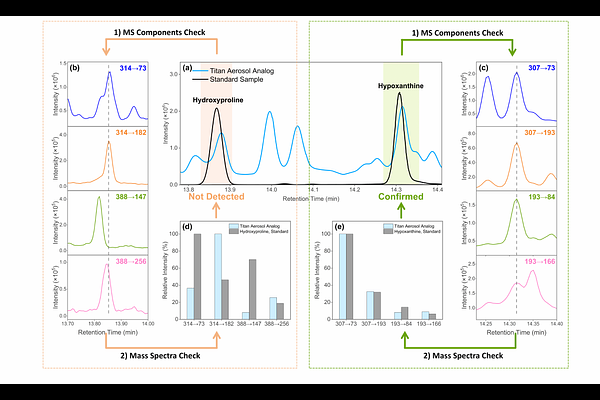
AbstractBuilding blocks of life such as amino acids, nucleobases, and fatty acids are central to prebiotic chemistry and represent key targets in the search for planetary biosignatures. In planetary materials, biomolecules typically occur at trace levels within complex matrices, posing substantial analytical challenges, particularly for quantitative characterization. Here we develop a gas chromatography tandem mass spectrometry method that enables robust qualitative and quantitative analysis of 56 prebiotically relevant molecules. The method is applied to a Titan aerosol analog and, for the first time, to a Martian gypsum analog from the Qaidam Basin, revealing diverse inventories of amino acids, nucleobases, and fatty acids in both samples. In the Titan aerosol analog, the first detection of phenylalanine and an extensive inventory of fatty acids, together with elevated nucleobase abundances, offers new insights into atmospheric photochemical synthesis of prebiotic molecules. In the Martian analog sample, amino acids are detectable and exhibit pronounced biotic abiotic contrasts in abundance patterns relative to those observed in the Titan aerosol analog, whereas fatty acids show more overlapping abiotic and biotic signatures, highlighting the potential of amino acids as robust biosignatures. These results provide quantitative constraints on prebiotic chemical evolution and underscore the utility of GC-MS-MS for biosignature identification in planetary exploration.