Gravitational Wave Hyperbolic Catalog: Reanalyzing High-Mass Gravitational Wave Signals Using Hyperbolic Waveforms

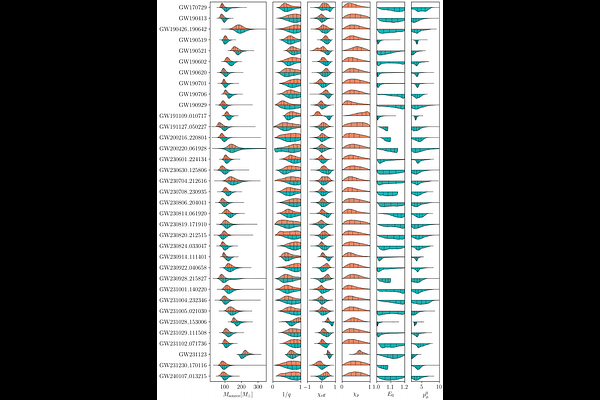
Gravitational Wave Hyperbolic Catalog: Reanalyzing High-Mass Gravitational Wave Signals Using Hyperbolic Waveforms
Jacob Lange, Danilo Chiaramello, Peter Lott, Chad Henshaw, Alessandro Nagar, Richard O'Shaughnessy, Laura Cadonati
AbstractClose hyperbolic encounters between black holes produce distinctive bursts of gravitational radiation with a time-frequency morphology that is qualitatively different from that of quasi-circular inspirals. Expected to arise in dense stellar environments through dynamical interactions, these encounters probe formation channels and mass ranges inaccessible to isolated binary evolution, making them a compelling target for current and next-generation detectors. In this work, we reanalyze \totalevents high-mass events from the LIGO-Virgo-KAGRA catalogs using the hyperbolic configuration of the~\dali~waveform model. We compare these with analyses using the quasi-circular, precessing configuration of the same model, computing Bayes factors to evaluate which description is favored by the data. We find that most events strongly to mildly favor the quasi-circular, precessing scenario, except for GW190521. For this event, we find that the signal is best fit by a dynamical capture waveform, with Bayes factor $\ln \mathcal{B}^{\rm hyp}_{\rm prec}=3.71^{+0.11}_{-0.11}$. We confirm this preference via further analyses with~\dali~in different configurations (quasi-circular, non-precessing; eccentric, non-precessing; and eccentric, precessing), as well as one using the quasi-circular, precessing numerical relativity surrogate model \nrsur. We also highlight the results we obtain for GW231123, another high-mass signal linked to evidence of strong precession, for which we find strong preference for the quasi-circular, precessing scenario, with $\ln \mathcal{B}^{\rm hyp}_{\rm prec}=-15.80^{+0.24}_{-0.24}$. The analysis of mock signals generated with the best fitting waveforms for GW190521 and GW231123 suggest that the former might belong to a region of parameter space where high-mass, bound, precessing signals can be hard to distinguish from dynamical captures in parameter estimation.