Pitching Cosmic Curveballs: Environmental Effects on Extreme-Mass-Ratio Inspirals with Spinning Secondaries

Pitching Cosmic Curveballs: Environmental Effects on Extreme-Mass-Ratio Inspirals with Spinning Secondaries
Leif Lui, Lisa V. Drummond, Alejandro Torres-Orjuela
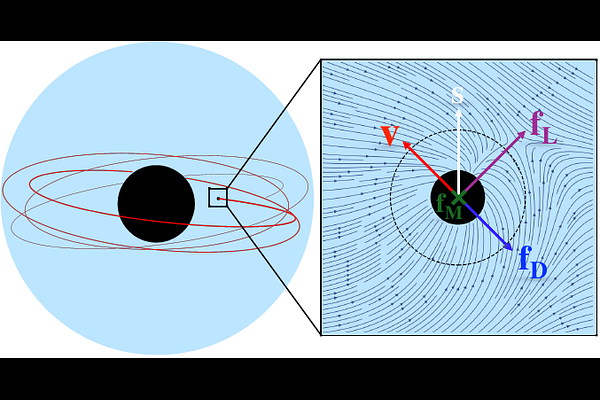
AbstractMuch like the aerodynamic deflection of a spinning curveball, a rotating secondary in an extreme-mass-ratio inspiral (EMRI) experiences Magnus and lift forces, in addition to the standard drag force, when traversing a gaseous environment. We present the first framework that incorporates these specific spin-coupled environmental effects (EEs) into the evolution of EMRI. Over the multi-year observation windows of space-based gravitational-wave (GW) detectors, these interactions imprint a unique, distinguishable dephasing signature on the signal. Crucially, a Fisher matrix analysis reveals that gas drag breaks the fundamental vacuum-projection degeneracy between the secondary's spin magnitude and inclination, thereby tightening parameter constraints. Thus, accounting for EEs is not merely a modeling necessity, but a powerful tool for enhancing the detectability of the secondary's intrinsic spin, and could serve as a novel probe of accretion flows harboring massive black holes.