On the feasibility of inverting the rotation of the solar core with mixed f/g modes

On the feasibility of inverting the rotation of the solar core with mixed f/g modes
Armand Leclerc, Arthur Le Saux, J. M. Joel Ong, Rafael A. Garcia
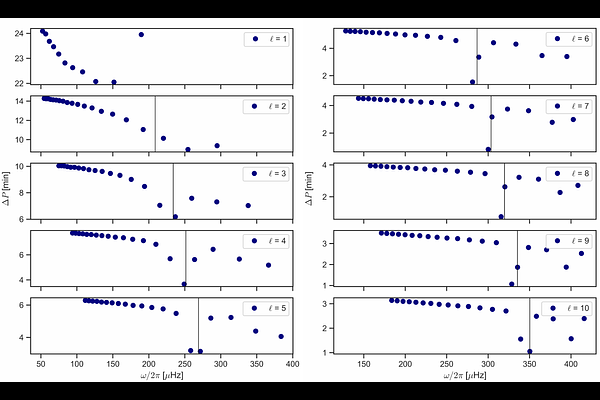
AbstractContext: Thanks to helioseismology, the rotation profile of the Sun has been measured with great precision down to 20% of its total radius. This rotation profile is used as a calibration to infer the rotation of other stars as well as a test of angular momentum transport theory in stellar interiors. However, the deepest 20% of the layers remain out of reach of current observations, preventing astronomers to discriminate between currently competing angular momentum transport mechanisms. Aims: The main obstacle is that no global oscillations modes sensitive to rotation (non-zero degree l) reaching the solar core have been detected yet, as nonradial p modes cannot reach it and g modes are evanescent at the surface and still elude detection. In this work, we propose and examine a new method to constrain the rotation of the core of the Sun, which does not require direct observation of solar g modes. Methods: It is based on a recent prediction that g modes in the radiative interior couple with f modes in the outer parts of the star. These mixed f /g are at the same time sensitive to the rotation of the core and able to reach the surface. These modes can be used together to build average inversion kernels and perform an inversion of the rotation of the solar core. Results: We find that the oscillations' spectrum of the Sun should present 6 mixed f /g modes that can be used to measure the rotation rate of the Sun at r = 0.07 and 0.2R. We estimate that the uncertainty on the measurements should be small enough to distinguish between competing scenarios of angular momentum transport in the Sun.